
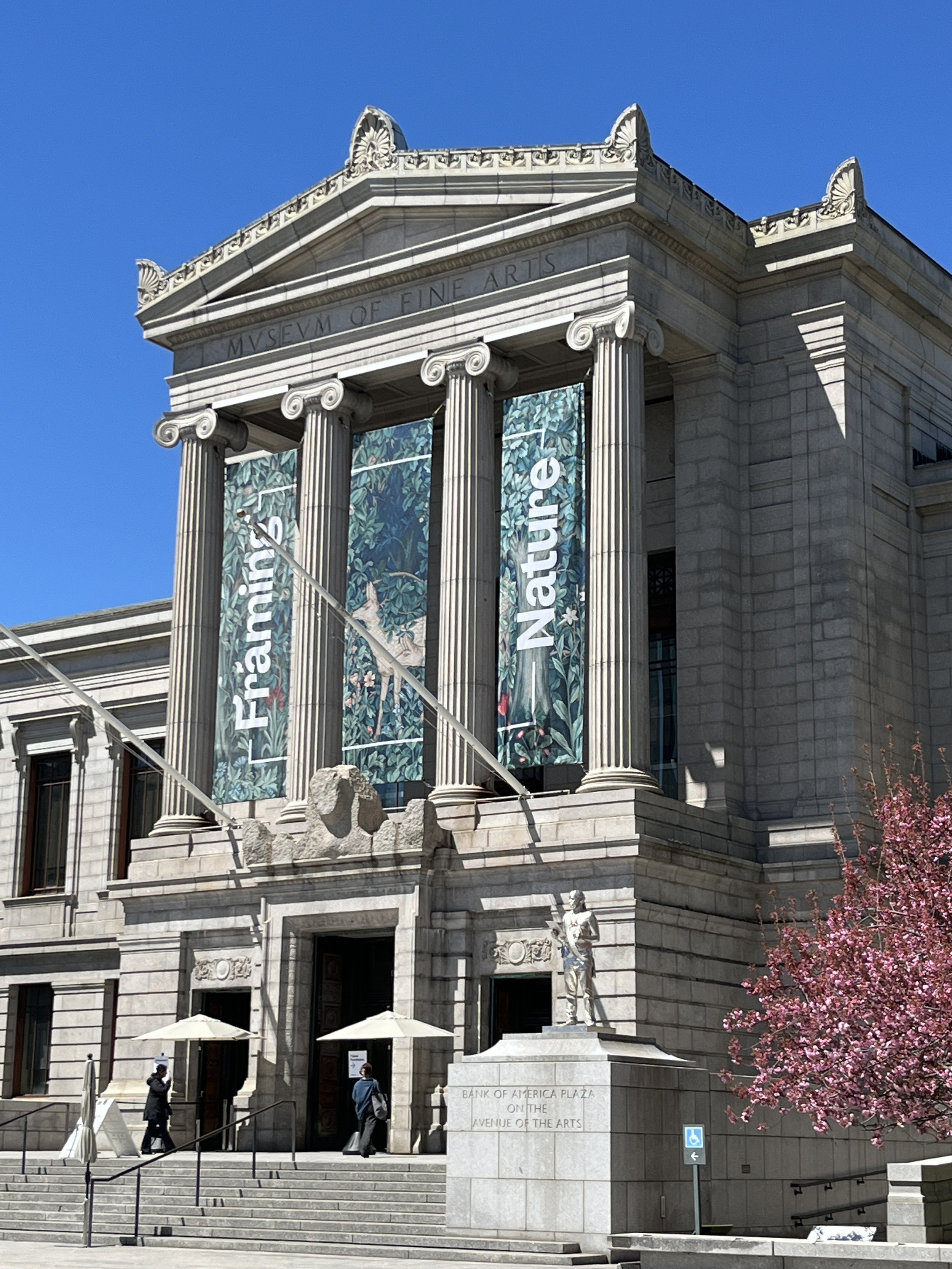
Museum of Fine Arts, Boston
Framing Nature: Gardens and Imagination, on view at the Museum of Fine Arts, Boston through June 28, 2026, offers a sweeping survey of the human fascination with gardens. Divided into categories that focus on such topics as “Gardens as Art,” “Gardens and Power” and the future of gardens, the exhibition brings artists—working in diverse media from across the globe and throughout history—into conversation to examine our desire to cultivate, contain and commune with nature.
Artists have long confronted the challenge of how to convey the grandeur of nature through two-dimensional media. A strength of the exhibition is the curatorial choice to incorporate large-scale works that create an immersive experience, evoking the sensation of physically inhabiting an outdoor garden. Immediately upon entering the exhibition, the viewer is met with a massive tapestry which fills the space. The dark paint on the walls creates a moody atmosphere which contrasts the sterility of the typical white gallery wall and envelops the viewer.
While there are many standout large-scale works included in the exhibition, I would like to highlight a few personal favorites. Yuan Yao’s Elegant Gathering in a Secluded Garden, dated to the mid-18th century, is an impressive series of twelve hanging scrolls which similarly occupies an entire wall. The artist fills the composition with elegant details against the backdrop of a wild mountain range, constructing vignettes throughout the piece which highlight different artistic endeavors. Yao presents an idealized garden intended to communicate the highest “aesthetic and formal standards of Chinese gardens rooted in centuries of literary and philosophical discussion.”(1) In this way the scrolls not only reflect the values and skill of the artist, but act as a manual for how gardens can be used to express human creativity and intellect.
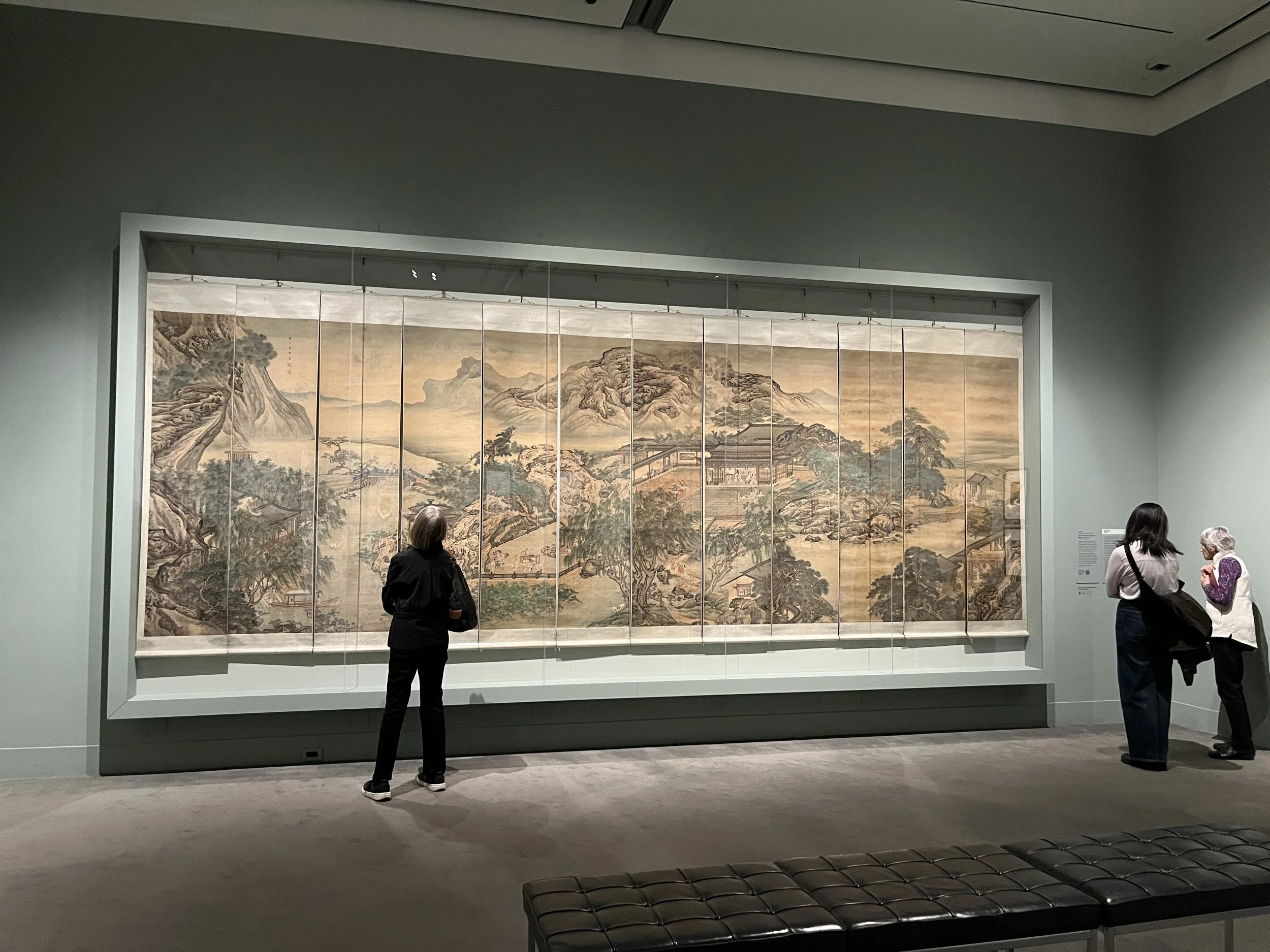
Installation view of Yuan Yao’s Elegant Gathering in a Secluded Garden
Andrew Raftery’s The Autobiography of a Garden comprises a multi-media installation of ceramic plates decorated with copperplate prints, installed on four panels of block printed wallpaper, one for each season. The project, which Raftery completed over the course of seven years in the early 2000s, documents his life through the lens of his work developing a garden through the phases of inception, growth, fruition and dormancy.(2) The ornate wallpapers and hanging ceramic plates printed with detailed drawings evoke Victorian interiors, but Raftery’s choice to include vibrant colors and designs that highlight local seasonal flora give the piece a contemporary feel. On the ceramic plates Raftery charts his progress in a series of self-portraits documenting the steps he took to establish his garden. In another contemporary detail, Raftery has designed the plates with edges shaped like various garden tools, contrasting the delicacy of the ceramic with the hard edges of digging and cutting implements. Raftery unites several modes of artistic expression, from landscape design to copperplate etching, to celebrate the work and creative expression of his garden.
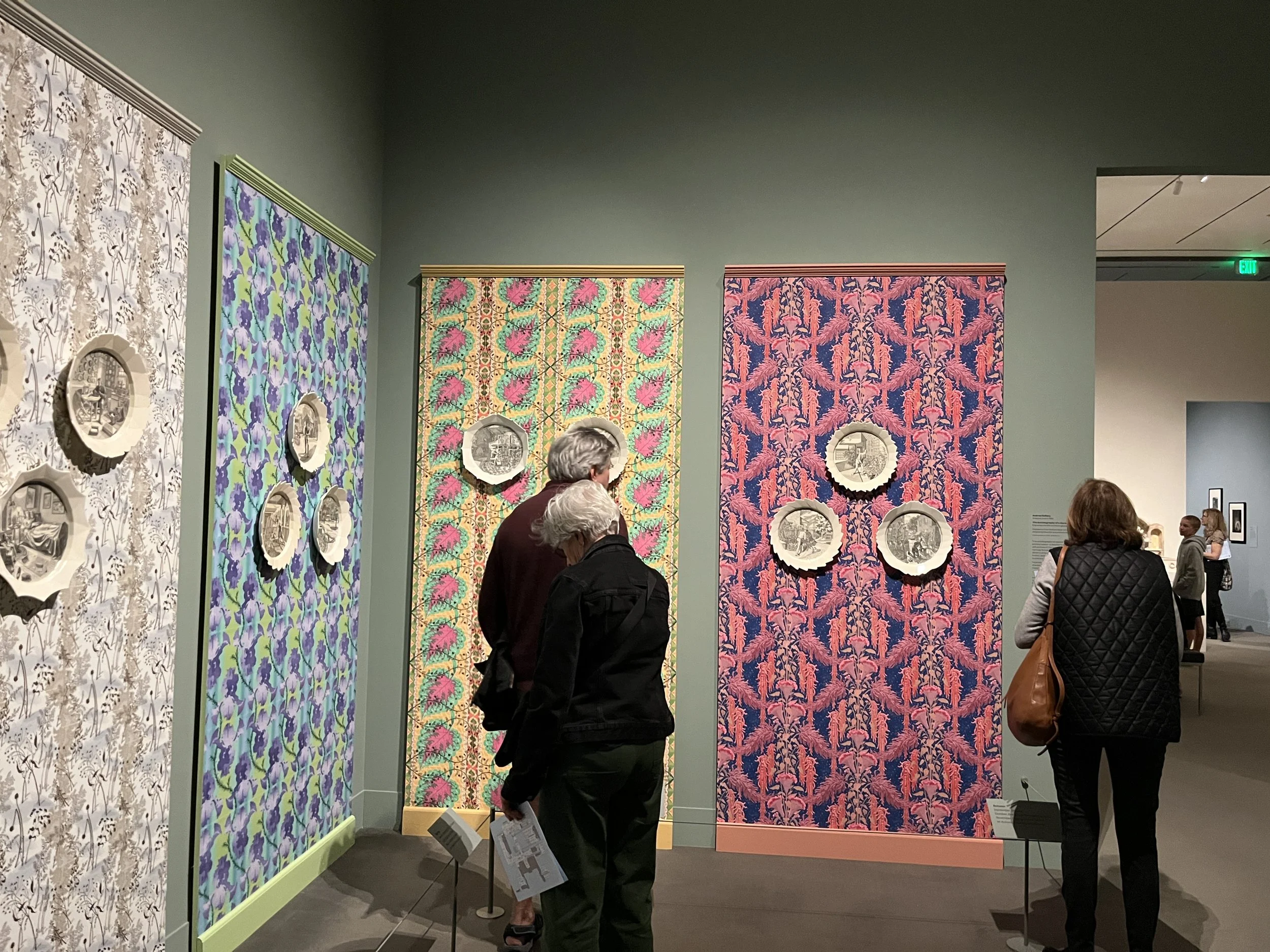
Installation view of Andrew Raftery’s The Autobiography of a Garden
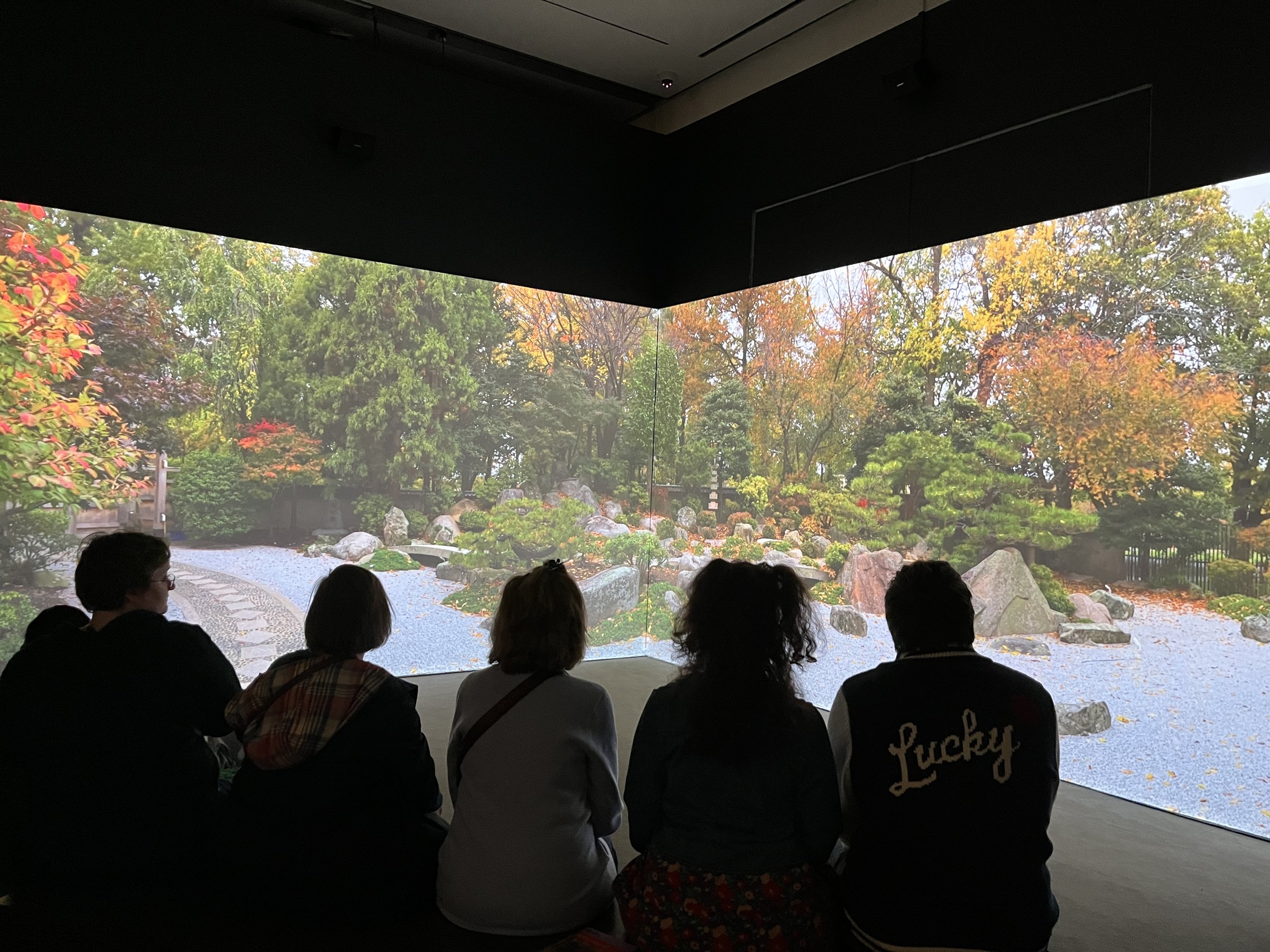
Video installation of Tenshin-en
A final noteworthy installation within Framing Nature is a video projection that fills an entire room of the exhibition and documents the seasonal changes experienced in the MFA’s Japanese Garden, called Tenshin-en, or the “Garden of the Spirit of Heaven.” Conceived as a means of educating the public about Japanese aesthetics, the garden occupied a gallery within the museum until it was relocated outside in the late 1980s. Japanese artist Nakane Kinsaku collaborated on the redesign of the garden to incorporate local rocks and flora, merging Japanese design principles with the Massachusetts landscape.(3) Though it is best to experience the garden in person, the immersive video installation gives the viewer a glimpse into the seasonal developments in the garden, transporting its charms into the gallery.
While the exhibition reveals many incredible stories about the artistic portrayal of gardens, a personal highlight was the inclusion of 13FOREST artist Claudio Eshun’s photograph Untitled (Our Family Garden). Eshun’s work frequently explores his experience as an immigrant; born in Ghana, raised in Italy, and finally settled in Worcester, Massachusetts, Eshun has experienced a sense of rootlessness throughout his life.
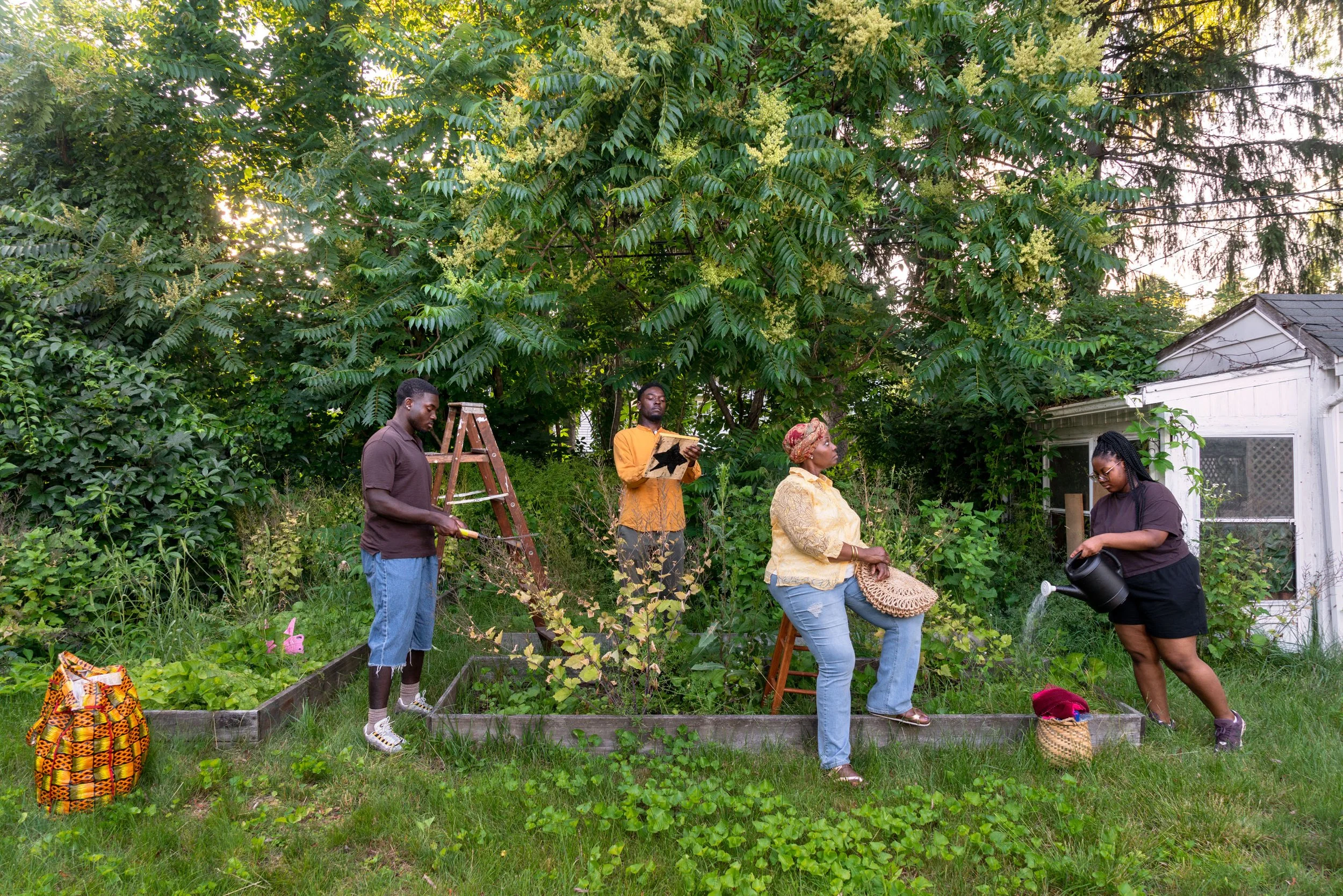
Claudio Eshun, Untitled (Our Family’s Garden), digital archival inkjet print
The photograph depicts the artist with his mother, brother and sister in their family garden. Initially inspired to capture the image due to the way the light filtered through the leaves, Eshun arranges himself and his family in classical, stoic poses which contrast the unruly greenery surrounding them.(4) Eshun’s mother grounds the image (and her family) as the foremost figure, a stately woman who presides over the activities of her children while taking a well-earned rest. Eshun assigned tasks to himself and his siblings that reflect their personalities and roles: his brother, who values precision, poses with hedge shears, while his sister, who is generous and nurturing, pours water from a watering can. As the artist of the family, Eshun takes his place at the rear of the composition, observing and documenting his family and their history.(5) The garden is not overly manicured or controlled; its wildness evinces a harmonious connection to nature and the land. Ensconced in the dreamy verdancy of their garden, Eshun’s family feels protected and secluded. Other subtle inclusions, like a distinctive Ghanaian traveling bag, hint at Eshun’s connection to his country of origin and the journey that he and his family took to arrive in Massachusetts.
The decision to represent his family in their garden reflects Eshun’s lifelong struggle with alienation and assimilation.(6) Through the act of tending a garden and working together, Eshun and his family literally and symbolically put down roots in their new home, fostering growth and life and claiming their place in an environment that is increasingly hostile to immigrants and Black people.
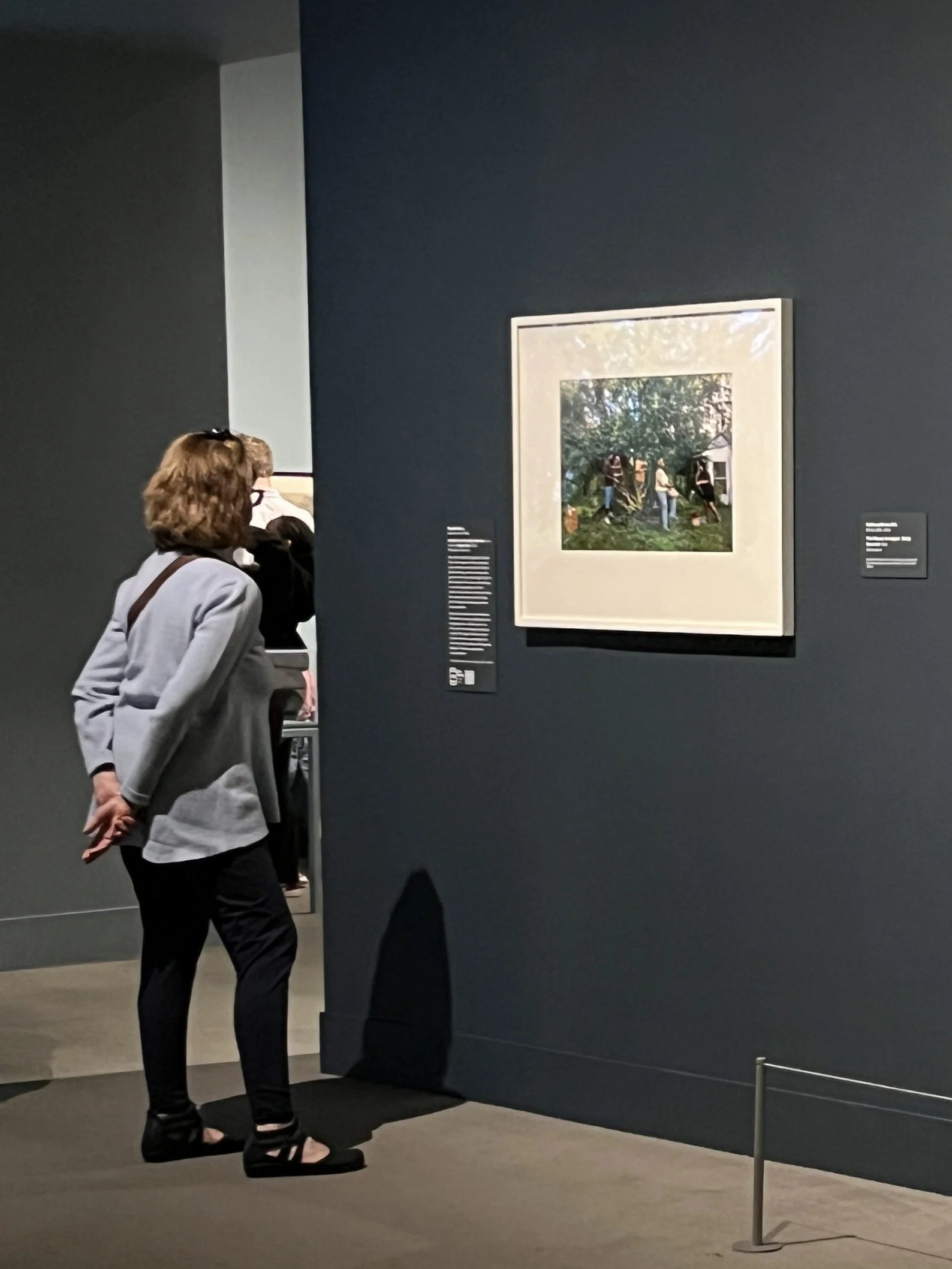
Installation view of Eshun’s photograh
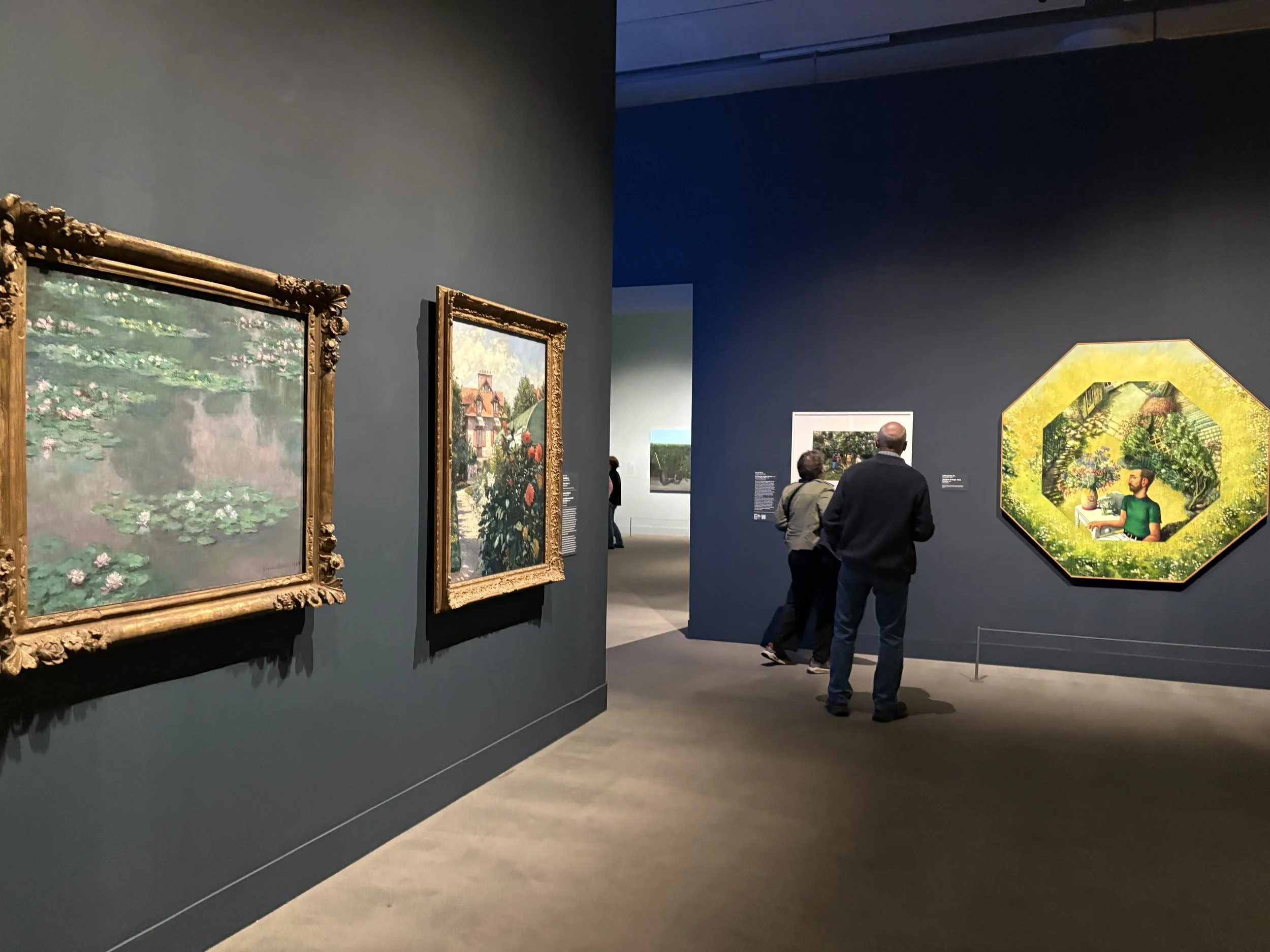
Installation view of Eshun’s photograph near a painting by Claude Monet (leftmost painting)
Eshun’s inclusion in Framing Nature creates moments of compelling dialogue between his work and the other featured pieces. Eshun, who goes by Claude, was included (with a wink) in a gallery near painter Claude Monet, who drew heavily upon gardens for inspiration for his groundbreaking paintings. While many interesting links can be made with Eshun’s work and other pieces in the show, a particularly fruitful comparison is drawn between his photograph and the work of Tyler Mitchell.
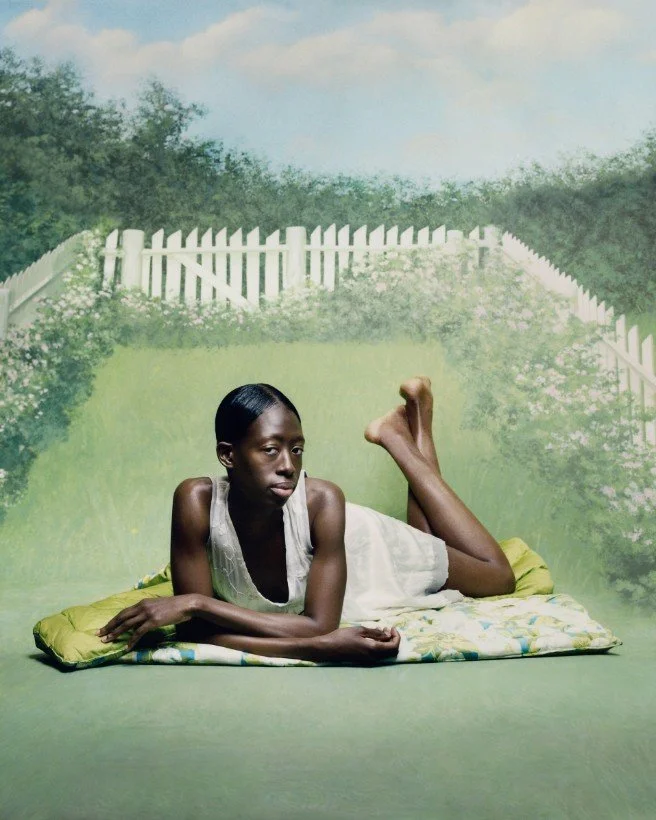
Tyler Mitchell, Cage, archival inkjet print
Mitchell’s photograph, Cage, is a large-scale print depicting a Black woman relaxing in front of a painted backdrop of a garden. The woman makes direct eye contact with the camera, though her gaze is soft and dreamy. Mitchell is an American photographer whose work often depicts the everyday lives and leisure activities of Black Americans, while hinting at the psychological state of vigilance that also marks their lives.(7) As in Eshun’s photograph, the garden is not overly manicured and the plants appear to grow in a robust and organic fashion. However, Mitchell’s garden is completely fabricated and hemmed in by the inclusion of a white picket fence, a quintessential piece of American nostalgia. The use of a painted backdrop refers to a popular style of African-American studio photography that creates an idealized reality.(8) For Mitchell, these portraits “represent a hopefulness for opportunity and a new life…Wrapped up in those backdrops is the desire for upward mobility and freedom.”(9) However this mobility is more complicated for Black Americans. In contrast with the Edenic ephemerality of the backdrop, the title of the photograph, Cage, complicates the seeming virtue of the white picket fence dream. When considered together, Eshun and Mitchell’s photographs speak to the powerful desire of Black Americans and immigrants to foster their own places of beauty and belonging amidst constant threats of exclusion and dispossession.
The Museum of Fine Arts, Boston’s exhibition Framing Nature: Gardens and Imagination fulfills the promise of its title, offering up a variety of artistic works that celebrate human creativity in conjunction with nature. We at 13FOREST offer our deep congratulations to Claudio Eshun for the fantastic achievement of his inclusion in this ambitious exhibition - make sure to catch his work and the rest of the installation before it closes on June 28, 2026.
Caitee Hoglund, Gallery Director
Notes
1. Elizabeth Dospěl Williams, Gardens and Imagination: Framing Nature in Art, (MFA Publications, 2026), 37.
2. Object label for The Autobiography of a Garden, 2009-2016 by Andrew Raftery, in exhibition “Framing Nature: Gardens and Imagination” at the Museum of Fine Arts, Boston, Boston, MA.
3. Object label for Tenshin-en video installation, in exhibition “Framing Nature: Gardens and Imagination” at the Museum of Fine Arts, Boston, Boston, MA.
4. Claudio Eshun, “Claudio Eshun on ‘Untitled (Our Family’s Garden)’” Framing Nature: Gardens and Imagination, Museum of Fine Arts, Boston, 2026. Video, 1 min. https://www.mfa.org/video/claudio-eshun-on-untitled-our-familys-garden
5. Eshun, “Claudio Eshun on ‘Untitled (Our Family’s Garden)’”
6. Courtney Leigh Harris, Gardens and Imagination: Framing Nature in Art, (MFA Publications, 2026), 126.
7. Meghan Melvin, Gardens and Imagination: Framing Nature in Art, (MFA Publications, 2026), 69.
8. Fi Churchman, “Tyler Mitchell At The Threshold,” ArtReview, October 6, 2022, https://artreview.com/tyler-mitchell-at-the-threshold-chrysalis-gagosian/
9. Churchman, “Tyler Mitchell At The Threshold”
Bibliography
Churchman, Fi. “Tyler Mitchell At The Threshold” ArtReview, October 6, 2022. https://artreview.com/tyler-mitchell-at-the-threshold-chrysalis-gagosian/
Eshun, Claudio. “Claudio Eshun on ‘Untitled (Our Family’s Garden)’” Framing Nature: Gardens and Imagination, Museum of Fine Arts, Boston, 2026. Video, 1 min. https://www.mfa.org/video/claudio-eshun-on-untitled-our-familys-garden
Object label for Tenshin-en video installation. In exhibition “Framing Nature: Gardens and Imagination” at the Museum of Fine Arts, Boston, Boston, MA. Seen on: April 23, 2026.
Object label for The Autobiography of a Garden, 2009-2016 by Andrew Raftery. In exhibition “Framing Nature: Gardens and Imagination” at the Museum of Fine Arts, Boston, Boston, MA. Seen on: April 23, 2026.
Williams, Elizabeth Dospěl, Karen E. Haas, Courtney Leigh Harris, and Meghan Melvin. Gardens and Imagination: Framing Nature in Art. MFA Publications, 2026.