History unified: the remarkable work of Firelei Báez in Denmark and Boston

“My works are speculative propositions, meant to create alternate pasts and potential futures, questioning history and culture in order to provide a space for reassessing the present.”

The quote is from Firelei Báez, a Dominican-American artist whose recent paintings and installations are circulating the globe in two expansive exhibitions. Earlier this year, I was fortunate to be in Denmark while one of the shows, Trust Memory Over History, was being featured at the Louisiana Museum of Modern Art. In one room after another, large-scale paintings of mythic figures, personifications, pulsating still lifes and augmented maps hung on the walls. Each bore the mark of an artist in her prime. Returning to Boston, I encountered the second exhibition, Firelei Báez, at the ICA and was amazed to find an entirely separate body of work of the same size, quality and depth. The combined shows represent ten years of Báez’s prodigious output that corrects white, Eurocentric history by annotating it with the beliefs, lives, customs and perspectives of peoples who were swept up in its global expansion.

Báez is an apt storyteller whose ability as a painter can hold visitor attention to her varied iconography and extended, multilingual titles. She informs viewers of her heritage as a Dominican woman, of philosophy born from the oppression of Afro-Caribbeans, of voyages of African slaves and of worldviews shared by non-Europeans. Then, with surprising deftness, she binds all of it into an ever-present history from which no one is exempt. To follow is an overview of a portion of Báez’s paintings and installations from her exhibitions in Denmark and Boston. Whether at the ICA or elsewhere, seeing her work is an imperative for its artistry and intelligence. Its timing is also relevant, for as Americans we live in a country in which the lives of people of color are excluded from schoolroom history so as not to upset white students, and politicians secure popularity by questioning the racial heritage of their opponents. 

Untitled (Map of Greenland’s west coast, 3 degrees south of the colony and 2 degrees north of the colony; year 1724, explored by Hans Egede, missionary), 2023, Acrylic and mica on digital print transferred to vinyl, 180" x 268"

Untitled (Map of Greenland’s west coast, 3 degrees south of the colony and 2 degrees north of the colony; year 1724, explored by Hans Egede, missionary), 2023, acrylic and mica on digital print transferred to vinyl, 180" x 268"

A cresting wave 10 feet high and 22 feet across greeted visitors as they entered Báez’s exhibition at the Louisiana Museum of Modern Art. Rising from a storm, the behemoth churned sand and displaced everything in its path from a settled state. Behind it, an even larger wave loomed with the suggestion that the cycle of destruction and generation would never cease. This was Báez’s painting Untitled (Map of Greenland’s west coast, 3 degrees south of the colony and 2 degrees north of the colony; year 1724, explored by Hans Egede, missionary). She created the work from acrylic paint and mica laid on top of a crude eighteenth-century map of Greenland. Though beautiful, it captured the violence of the sea and of colonial history. The Hans Egede referenced in the work’s title was a Danish explorer and missionary who, with his wife, set out from Europe to convert the Inuit of current-day Greenland to Christianity. By their own criteria they were successful, and in the 1730s Egede proudly demonstrated that point by bringing a converted Inuit child with him to Europe to impress his mission’s funders. When Egede returned Greenland a few years later, he inadvertently introduced to the continent smallpox, to which the Inuit had no immunity. The result was catastrophic.

On her approach to creating this painting and others Báez states “I think if I just gave violence it’s very easy to just look away. That is our biggest power at the moment: who do we give our attention to?” In the immense wave of Untitled, the artist addresses a known fact of European colonization but adds to it the lesser-known story of the Inuit, which still churns. Today Greenland is nearly 90% Inuit yet Egede remains a national saint. This ongoing tension is evident in the number of statues of Egede that dot the continent and the frequency with which Decolonize now! is spray painted across their plinths.

Black quantum physicists (Duppy for Delacroix), 2023, oil and acrylic on archival printed canvas, 71 1/8" x 71 1/8"

Historical persistence is a strong theme in Báez’s work. To vary its framework she draws from a vast number of disciplines such as science, history, biography and oral tradition. In one painting she successfully merges Afro-Caribbean folklore with quantum physics, a tenet of which is that information from the past is conserved and continuously ripples through time. In Black quantum physicists, Báez has painted a looming spirit onto an eighteenth-century map that a French perfumier had resurrected in 1935 to promote its long history as a purveyor of exotic scents to Europeans. At the bottom of the map, the company’s reliance on French-colonial slave labor is betrayed by the figure of a white man lording over two Black women as they gather berries to be processed into perfume.

The spirit Báez includes is a duppy, which to many Caribbeans and Africans is a spirit, often of a dead person, that roams the earth for malevolent or benevolent purposes. Here it descends and looks compassionately at the two enslaved women, perhaps as an ancestor who had been condemned to the same fate of forced labor. By bringing attention to an inhumanity that was a decorative element in the original map, Báez disrupts the perfumier’s message of luxury and places the origin of its ongoing success into high relief. The main title Báez has assigned to the painting alludes to the lingering Black experience of European imperialism, which dominant white culture would rather minimize or forget. Her subtitle, in the meantime, wishes the malevolent force of a duppy on systems that erase people of color as autonomous humans, a feat that French artist Eugene Delacroix performed in his nineteenth-century misrepresentations of Moroccans and Algerians.

A Drexcyen chronocommons (To win the war you fought it sideways), 2019, two paintings, hand-painted wooden frame, perforated tarp, printed mesh, handmade paper over found objects, plants and books, 373 1/4" × 447 1/8" × 157 1/8"

Báez expresses a three-dimensional relationship between past and present in a contemplative installation titled A Drexcyen chronocommons (To win the war you fought it sideways), which is now at the ICA. The word Drexcyen is from a fable that the Black American music group Drexciya had developed to root their name in history. In it Drexciya is a suboceanic city inhabited by the water-breathing descendants of pregnant African women who were – in reality – thrown from slave ships during forced passage to the Americas. While addressing a historical fact forced onto African women, the fable’s element of perseverance gives them ultimate victory over their white captors. The women are remembered and in that sense they still live.

A Drexcyen chronocommons (To win the war you fought it sideways), Detail: Towards an unseen force, 2019, acrylic and oil on canvas, 83 1/2” x 47” x 2 3/4”

Passing through either of two portals to Báez’s A Drexcyen chronocommons, visitors enter a vast space of dappled light defined by ceiling and wall suspensions of perforated blue tarp and printed white mesh. The environment is calming in its conveyance of the amorphous qualities of both subsurface water and a starry night sky. Near the installation’s center, hanging opposite one another, are two paintings of Black women wearing tignons, head coverings that eighteenth-century women of color were legally required to wear in New Orleans. The women’s eyes are observant but their faces are rendered without mouths, thus they remain solemnly mute.  These are the Drexcyens, women whose stories cannot be told but whose lives extend into the present. Above them is an undulating blue tarp, into which Báez has cut a chart of stars that hovered over Hispaniola on August 21, 1791, when the island’s slaves began a five-year revolt against the French colonial government. Victorious, they established the nation of Haiti.

This blue container of water, air and light combines history and memory into a living story. Haiti and the stars are still here and poignantly attached to them are the lives of countless Africans who died in the anonymity of the sea. There is a terrible beauty to Báez’s installation, a racial narrative that we willingly or unwillingly carry with us by dint of ancestry and shared space.

Untitled (Les tables de géographie réduites en un jeu de cartes), 2022, oil, acrylic and inkjet on canvas, 105" x 82"

Báez is masterful in balancing tensions in her work. When they break, though, furor comes to the surface. Two examples of this at the ICA are her paintings Untitled (Les tables de géographie réduites en un jeu de cartes) and Fruta fina, fruta estraña (Lee Monument). Untitled she began in 2022 while living in Rome during an artist residency. In that city’s public art, and in Italian art generally, horses are depicted as beasts that have been tamed to serve the will of high-ranking humans and gods. In Untitled, however, they stampede across the canvas with a ferocity that nearly obliterates an image beneath them. Looking closely, the viewer finds traces of a sheet of 52 playing cards that had been designed in seventeenth-century Europe as a lark to commemorate the kings, queens and explorers who had colonized Africa, Asia and the Americas. A fact omitted from the playing deck is that the same people had killed and enslaved millions of the continents’ indigenous peoples and disrupted entire civilizations. Therefrom comes the explosive energy of Báez’s horses, which she imbues with apocryphal beauty.
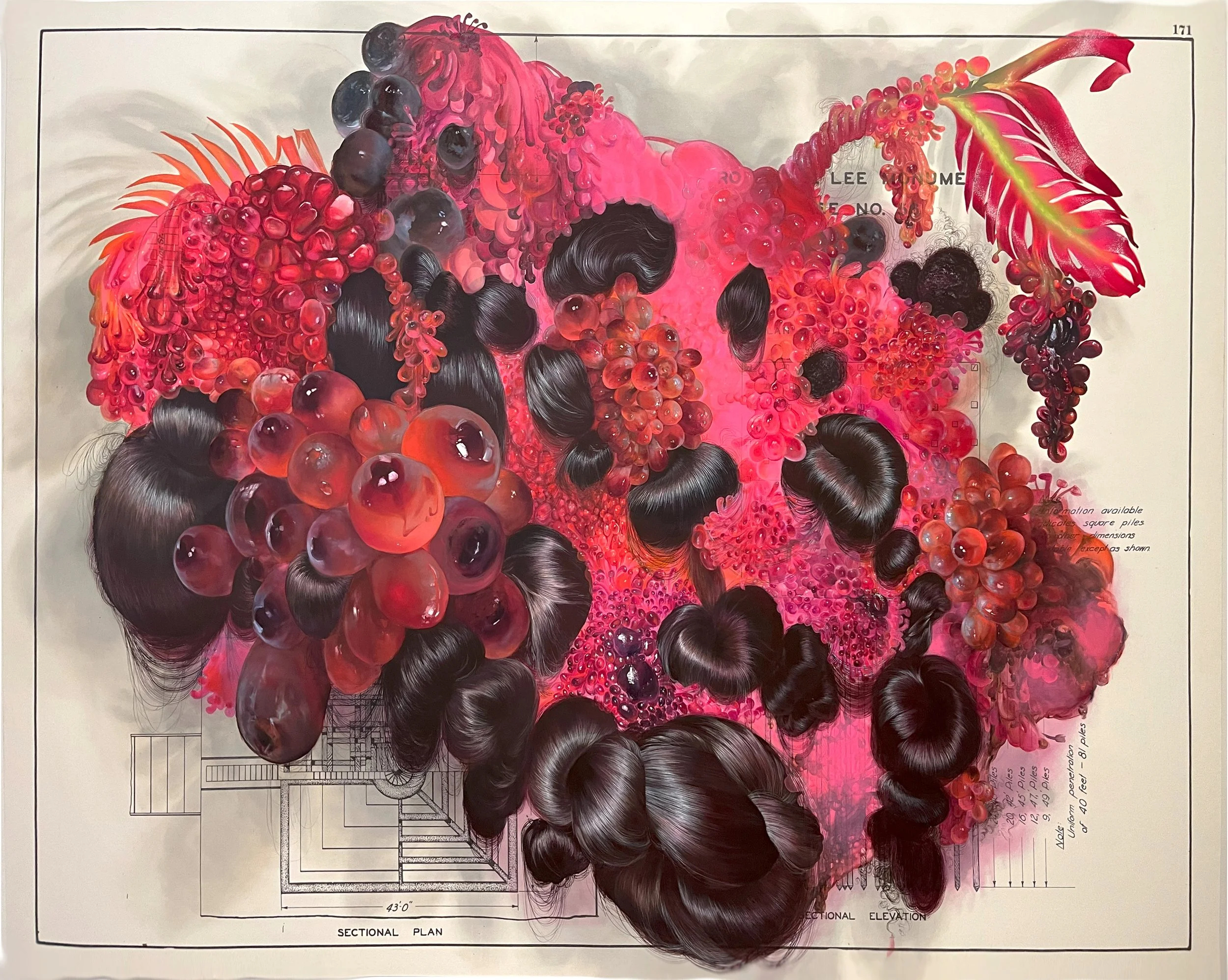
Fruta Fina, Fruta Estraña (Lee Monument), 2022, oil and acrylic on archival printed canvas, 88 1/4" x 111"

The other ICA painting, Fruta fina, fruta estraña, references Strange Fruit, a song about lynching that Black American singer Billie Holiday made famous by her 1939 recording of it. The song’s opening verse is “Southern trees bear a strange fruit / blood on the leaves and blood at the root / Black bodies swinging in the southern breeze / strange fruit hanging from the poplar trees.” Here Báez paints atop an 1885 architectural plan for a monument to Confederate general Robert E. Lee. Seemingly eating away at the plan is a mass of plant life and hair buns. The latter alludes to people of color throughout the Americas who for centuries have tried to conform to white expectations by forcing their own hair into foreign straightness. The mass is deadly yet generative: it evokes the monumentality of oppression and the historical persistence of people of color who have - and have not - survived it.

On her ability to depict the terrible and the lush, the repulsive and the attractive Báez states, “I’m fully capable of making a juicy, beautiful painting that is just all pleasure. And that’s good. But that only sustains for a short period of time. I’m interested in giving something that is generous enough to make it linger in your mind afterwards.”

The degree to which Báez can incorporate concepts into her work reaches a crescendo in a painting and an installation at the ICA. The concept presented here is opacity, a mode of being developed by the late intellectual Édouard Glissant. Born in Martinique, Glissant produced a monumental body of work that addresses colonialism and racism, and that proposes a means by which human diversity can flourish in peace. Opacity is Glissant’s call for all people to control what others know about them and simply accept everyone as inherently equal. His thinking is a direct attack on Western hierarchies based on perceived human differences and the oppressive superior/inferior dynamics that flow from them. "I reclaim for all,” Glissant wrote, “the right to opacity, which is not confinement. Let it be a celebration.”

Madeleine (Rupture rapture maroonage), 2022, oil and acrylic on canvas panel, 113 1/2" x 78"

At the ICA Báez addresses opacity in her painting Madeleine (Rupture rapture maroonage), which uses as a baseline an 1800 portrait of a Black woman painted by French artist Marie-Guillemine Benoit. In the original, Madeleine wears a white head wrap that conceals her hair as she sits silently with one of her breasts exposed. People normally view her as an object that they can understand, like or dislike based on her attributes. Báez disrupts this process In her re-treatment of Madeleine, however, by cropping out the subject’s body and covering her face with an opaque burst of yellow, orange and purple paint. It seems to emanate from Madeleine herself and leaves only a portion of her now-lavender head scarf visible. Gone are all references to her color, her countenance, her thoughts – everything that could be used in judgment for or against her. Remaining is the impression of a person whose opacity has reduced her (or elevated her) to the status of simply human.

Báez brings opacity to a multidimensional level with her installation Adjusting the Moon (The right to non-imperative clarities). Stepping through its single portal, viewers enter a 14' x 24' x 10' room lined with mirrors that cast infinite reflections of itself and anything inside it. The ends are flanked by two paintings similar to Madeleine. They are Adjusting the Moon (The right to non-imperative clarities): Waning and Adjusting the Moon (The right to non-imperative clarities): Waxing, both with figures that Báez has obscured with bursts of color. When visitors enter the installation, they do so with a great deal of self-knowledge and a related battery of comforting and disquieting opinions about themselves., all of which get amplified by the mirrors. While I watched people navigate the space, many with eyes to the floor, it became evident that they were having an easier time looking at images of Báez’s concealed portraits than of themselves. Comfort and acceptance came when the details of self were unknown.

The visitor experience of Adjusting the Moon, the ICA states, links Glissant’s philosophy of opacity with the ongoing history of Black people and other people of color who control over dominant cultures know about them so they can sidestep opinion and navigate space more freely.

Adjusting the Moon (The right to non-imperative clarities), mirrored room with two paintings, approximately 14' x 24' x 10’. Detail: Adjusting the Moon (The right to non-imperative clarities): Waning, 2020, oil and acrylic on panel, 114” x 117”

Báez takes a considerable risk in making public a body of work that builds history from the biographies, beliefs and traditions of people who once had limited or no contact with each other. History is a tangle of causes and effects that accumulate over time. European colonialism, for instance, was not something that flared up and burned itself out; today it ripples through everything from the languages we speak to the food we eat, from the mates we choose to the wars we wage. The effects of colonialism is in our DNA. How, then, can an artist tell the stories of Caribbeans, Africans and indigenous peoples but not lock them into the past or have them construed as “other” by viewers?  Báez tackles the question repeatedly in her work, but two paintings in particular bind her stories and corrected histories into one persistent whole.

In Tone tonal time (or an economy of care) at the ICA, she uses as her base a reproduction of a seventeenth-century, multilingual map that charts Earth’s 32 pervasive wind directions. Painted on top of it are a still life of abundance to the West and an anonymous female figure to the East. The two are independent of one another, as though from different worlds, except toward the middle of the map. There they become an inseparable blur, seemingly locked together in a yin/yang of consumption and production, enjoyment and toil. It is the dynamic of colonialism and slavery, of capital markets and international consumerism. Standing before the painting, viewers might be hard pressed to consider themselves as occupying some magic space outside of that dynamic.

Tone tonal time (or an economy of care), 2024, oil, acrylic and inkjet on canvas, 88" × 110"

In Denmark, Báez expressed the concept of human interrelatedness through her work Untitled (Transito de la sombra y penumbra de la Luna sobre la superficie de la Tierra). Here she painted in nature’s cool and warm tones a female figure resting across a crude map of the Western Hemisphere. The map was drawn in 1778 by Mexican astronomer Antonio de Leon y Gama to plot the cross-continental course of a solar eclipse that had occurred that year. Báez’s figure stretches along the same path, from Africa, to the Caribbean and on to the western shore of present-day Mexico and California. This natural line of cast darkness also traces the spread of European colonialism. Unlike an eclipse’s linear, east-to-west path affecting one geolocation at a time, Báez’s figure has no compass direction or movement; its stillness unites points on the globe into a single time and space.

Untitled (Transito de la sombra y penumbra de la luna sobre la superficie de la tierra), 2021, oil and acrylic on printed canvas, 78 1/2" x 114 3/8"

The philosophical point Báez makes here is immense, for it defies the white European notion of history as the unidirectional, westward movement of its own people and culture. History is not such an exclusive domain. It is the back-and-forth movement of all people; we rise and fall unevenly but in unison. As suggested by the sand in Báez’s painting of endless waves, time churns everything in its path into one complex story.

All of us are in it. Now.

  • Jim Kiely

ICA Boston’s Firelei Báez exhibition Firelei Báez will be on view through September 2, 2024. A separate exhibition of her work, titled Trust Memory Over History, closed at the Louisiana Museum of Modern Art in Denmark and is currently on view at the Kunstmuseum in Wolfsburg, Germany.

Arlington Porchfest 2024


Join us on Saturday 6/15 from 12-6 pm for Arlington Porchfest! On Mass. Ave, Maxima, Anthony’s Barber Styling and 13FOREST are hosting bands from 2-6 pm, as well as many other great porches in the surrounding area.

We are excited to welcome American Ink at 4 pm at 13FOREST - check out the full schedule below, as well as the many wonderful restaurants and shops in our neighborhood.

We are also pleased to offer a special promotion for Porchfest weekend - enjoy 10% off all items $100 or more now through Sunday 6/16.

And don't worry if you aren't able to make it to the gallery in person this weekend - if you see something you like on our website, just give us a call or email us and we’ll be happy to reserve the work you're interested in at the sale price.


Outside|In - meet the artists behind the Friends and Neighbors: Arlington Stories banner project


We are thrilled to continue our artist talk series Outside|In this spring with another conversation that highlights new public art around Arlington. Our previous talk was with Alex Cook, the artist who created the YOU ARE LOVED mural in Arlington Heights. On Saturday May 11 from 4-6 pm we will host a talk with the three artists who created the new banners for the Friends & Neighbors: Arlington Stories project, on view now on Mass Ave near Arlington Center. The banners, created by local artists Sonya Quinlan-Khan, Molly Scannell, and TJ Reynolds, feature Arlington residents who play an important role in the lives of the artists. Read more about the project below and see a preview of some of the work on display.



The Arlington Commission for Arts and Culture and the Arlington Division of Diversity, Equity and Inclusion invited artists Sonya Quinlan-Khan, Molly Scannell, and TJ Reynolds to explore some of Arlington’s diverse stories. Each artist created three portraits responding to the theme of “Friends & Neighbors” for display on lightpole banners in Arlington Center, choosing their own subjects.

The result – Friends & Neighbors: Arlington Stories – showcases people who are significant in the artists’ lives in Arlington: teachers, small business owners, musicians, community leaders, relatives, all essential to the fabric of our community. Molly, TJ and Sonya’s representations of their neighbors, each done in a style entirely their own, come together to remind us that though we look through different eyes, we are all intimately connected and each of us brings something worthy to our collective endeavor of building community.

In an age of polarization and isolation, now is the time to listen and hold each others’ stories. Art reminds us that this capacity is within us, if we can only slow down long enough to pay attention, and suspend our judgment to see with clear eyes. Let these banners brightly displayed on our flagpoles awaken you to the complex web of stories we all carry. Allow yourself to wonder about your neighbor, to appreciate who they are and all they have done, extend that same curiosity and gratitude to yourself, and Arlington will truly be a place of friends and neighbors.

The banners will be on view from mid-April through May 30, 2024. Many thanks to Nilou Moochhala, who designed our title banners and managed the printing process.


Dim Stars: Alien Transport Series

Scott Bakal’s Dim Stars: Alien Transport series, featured in the current exhibition Tall Tales at 13FOREST, is the culmination of several years of creative exploration. Starring Bakal’s long-running Dim Stars character, Dim Stars: Alien Transport reimagines classic American UFO sightings as encounters with Bakal’s friendly alien creature:

On July 26 1947, two days after Kenneth Arnold’s experience of seeing a flying object while flying his own plane, the press coined the term ‘Flying Saucer’ and ‘Flying Disc.’ The series is a collection of flying saucers and spaceships as seen in the early days of the phenomenon. Flying saucers started being spotted regularly, but they were always hazy descriptions or photos taken with the technology of the time. For the last 77 years, government agencies have been keeping what these ships actually looked like from the people. This is the world's first reveal of some of the planet's favorite flying saucers, what they really looked like, and who inhabited them.

Bakal’s interpretations of the Kenneth Arnold Sighting, the McMinnville UFO, and the Lubbock Lights comprise two paintings each, one with Bakal’s representation of the UFO from the sighting, and one showing the craft in use by the Dim Stars. In addition to the paintings, Bakal has compiled contemporaneous newspaper clippings, photos, and interviews for each sighting, which are linked below. You can see more work from Dim Stars: Alien Transport here.

Scott Bakal, The Arrival, acrylic and ink on panel


These paintings are sold as pairs.


Use the link here to find out more public and top secret information on the Kenneth Arnold Sighting, such as original drawings, audio recordings and news clippings, including comments from the National Air and Space Museum on this first historic event. This sighting coined the phrase ‘flying saucer.’


Scott Bakal, Kenneth Arnold Sighting, graphite and silver leaf on panel

Scott Bakal, Kenneth Arnold Sighting: Class One Fighter, acrylic and ink on panel


Use the link here to find out more public and top secret information on the McMinnville UFO, such as original photos, newspaper clippings, a LIFE magazine clipping and interviews with Evelyn Trent, wife of Paul Trent, who took the photos.


Scott Bakal, McMinnville UFO, graphite and silver leaf on panel

Scott Bakal, McMinnville UFO: Communications Vehicle, acrylic and ink on panel


Use the link here to find out more public and top secret information on the Lubbock Lights, such as original photos, newspaper clippings and video documentary. Includes top secret alien technology information never released to the public.


Scott Bakal, Lubbock Lights, graphite and silver leaf on panel

Scott Bakal, Lubbock Lights Hyperdrive Transport, graphite and silver leaf on panel


Outside|In - artist talk with muralist Alex Cook


Arlington has a vibrant public art program, and in the past 13FOREST Gallery's series Outside|In highlighted some of the artists whose paintings and sculptures enliven the community. (If you are curious about the series, you can read more here: 2017, 2018, 2019.) This year we are reviving Outside|In with an artist talk by Alex Cook, who last November completed a new mural in Arlington Heights as a part of his YOU ARE LOVED Project.

Cook's mural was commissioned by the Arlington Commission for Arts and Culture. Cecily Miller, the town's public art curator, arranged for Cook to create the mural, in addition to organizing 50 community volunteers to help complete it. Please join us on Saturday, March 2 from 4-6 pm for a conversation with Cook about his dual practice as a fine artist and public artist. A selection of his fine art will be on view at the gallery during the event.


Alex Cook

Cook has been a professional studio artist for over 30 years. During that time he has produced hundreds of paintings, drawings and other artwork through a diversity of media that includes acrylic, oil, watercolor, collage, sculpture and more. He sells his work throughout the US. As a public artist, since 1997 he has created over 240 murals in 25 US states and in Kenya, Nigeria, Guatemala, Australia and New Zealand. His public work focuses on community and spiritual themes expressed through storytelling and images of nature.

Alex Cook, Tall Trees with Diamonds, acrylic on canvas, 36” x 24”, sold

Throughout Cook’s career, he has taught art and creativity to people of all ages and in settings ranging from alternative high schools and court-ordered community-reintegration programs, to afterschool programs and summer camps.  While teaching in the Boston public school system, he founded a painting program for teenagers called Art Builds Community (ABC). From 2004 to 2009, ABC employed young artists in the summer and provided them with the technical skills to paint murals across Boston and the surrounding area. Many of Cook’s contemporary mural projects invite community members to add their own images to larger overall works so everything coheres within a common structure. Painting to Cook is only half of his public art; the other half is his creating environments in which community members find a love of creation and a connection to the world.

In 2014 Cook initiated a solo project titled YOU ARE LOVED, his aim of which was to produce murals that publicly proclaim the simple phrase You are loved. His project has since evolved to include residents of communities across the US who share a desire to influence public discourse on human value and self-worth. Today there are 110 YOU ARE LOVED murals adorning the walls of schools, homeless shelters, prisons and houses of worship in 15 states and two countries. In 2021 Cook’s experience of this project prompted him to author the book You Are Loved, Spiritual and Creative Adventures, A Memoir, which details his lifelong effort to bring beauty and love into the world.

Alex Cook, Four Birds, acrylic on canvas, 20” x 16”, sold

Alex Cook, View Towards Melbourne from the Dandanong Forest, acrylic on canvas, 16” x 20”, $700, available at 13FOREST


Alex Cook’s most recent YOU ARE LOVED mural, located in Arlington Heights on the west wall of Szechuan’s Dumpling at 1360 Massachusetts Avenue

It is important to Cook that his project’s three-word message be expressed in the broadest number of locations, and across the lines of geography, race, gender and socioeconomic status so it reflects the universal need of humans to be loved. His most recent mural is in Arlington Heights, on the west wall of Szechuan’s Dumpling at 1360 Massachusetts Avenue.

Cook's murals often give students, church congregants and residents the sole opportunity in their lives to create a permanent work of art. Anyone can join in regardless of skill or experience. Cook states that the result is always beautiful and that it instills a sense of pride and ownership among participants. Communities have many times used YOU ARE LOVED murals as their response to social afflictions such as gun violence and the rise of suicide among teenagers. In this context, Cook believes, the project's truthful statement to viewers as individuals operates on the far more complex level of the community collective.


Mini Maker Market

At 13FOREST one of the joys of our practice is working with artists who work in a wide range of media and experiment with different materials.

On Wednesday, December 6 from 6-8 pm we are hosting a Mini Maker Market featuring three of our talented artists who all make jewelry in addition to other types of objects. Each artist will bring a selection of new work and jewelry for the evening, with a variety of great pieces that would make the perfect gift this holiday season. Refreshments will be served!

Get a sneak peek of the featured artists below:


Heather Carroll is a visual artist and jewelry designer. She grew up helping her grandfather in his jewelry store on Long Island, which sparked her appreciation for the beauty found in the smallest of details. Her work exemplifies her playfulness, love of color and texture, creating compositions that are both distinct and classic.


Kimberly Huestis grew up in Vermont. Once a year, her family would trek to the coast of Maine to see the ocean, smell the salty sea air, and play in the sand. It is no coincidence she ended up in the Boston area. Specializing in hand-sculpted, wearable art for those nautical lovers out there, Huestis’ style is clean and fresh, with an organic touch of coastal elements and textures.


Ilana Krepchin’s creations combine a sense of fun and purpose with essential interests from her past. As a kid, she wanted to be an architect when she grew up - now she makes miniature buildings. Krepchin has always been drawn to mathematical concepts - now they inform her art, as in the miniature Mobius strips she makes.


East Arlington Holiday Hurrah

This year we are excited to participate in East Arlington’s Holiday Hurrah - an innovative new program created to thank our community for shopping small and supporting local business.

Make a purchase at any six participating businesses as you shop, dine and prepare for the holiday season around the neighborhood, get your card stamped, then redeem your card for a pair of free movie tickets at the Capitol Theater. Pick up your card at 13FOREST today and start earning your stamps!

Participating businesses:
Derby Farm & Flowers
Capitol Theatre
13FOREST Gallery
The Fox & Robbins Shop
Maxima Gift & Book Center
Inspired Gardens
Quebrada
Arlington Bakery
Yes!
Continental Salon
Town Tavern
Sleepy Dog Veterinary
Lotus Yoga Studio
Boon Noon Market
Inspire Fitness Studio
Breadboard Bakery
Clay Dreams
Anthony's Barber Styling

Dear Memories post-screening discussion with Lisa Kessler and Larry Volk


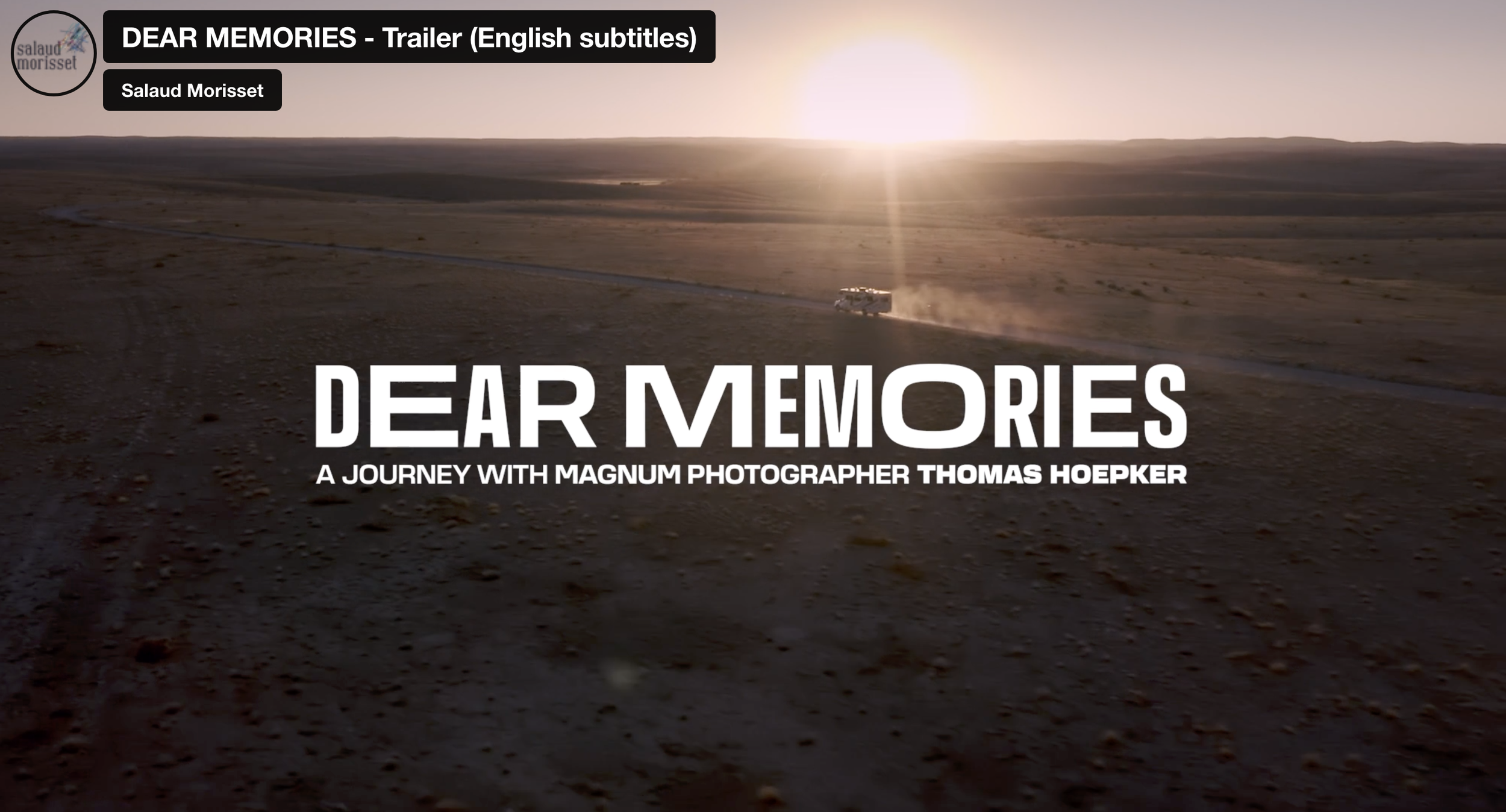
13FOREST Gallery is pleased to invite you to a special event hosted in partnership with the Arlington International Film Festival. Following the New England premiere of the film Dear Memories at the Capitol Theater on Saturday, November 4 at 2:45 pm, the public will be invited to a post-screening discussion at the gallery from 4:30-6:30 pm with two nationally recognized photographers and educators, Lisa Kessler and Larry Volk.

Written and directed by Nahuel Lopez, Dear Memories is a journey with the legendary German Magnum photographer Thomas Hoepker. One of the most important living photographers worldwide, Hoepker's pictures became icons of photojournalism. After a 2017 diagnosis of Alzheimer's disease, he embarks on his last big dream - a road trip through the USA with his wife Christine. Hoepker, the man whose art has become part of the collective memory, is now losing his own memories; all the while he continues to see life through his unique eyes and captures his visions on film for us to see.

Be sure to check the Arlington International Film Festival website for more great films being shown at the Capitol from November 2-5!


Featured Speakers


Lisa Kessler is a nationally recognized photographer and educator based in Boston. She is known for long-term projects on culture, education, health, and faith, including “the idea of the color pink in America;” the scourge of sexual abuse; young people in our public schools; and portraits of families coping with homicide.

Her work is in the permanent collections of the Cleveland Museum of Art, Philadelphia Museum of Art, and the Teaching Museum of Lehigh University. She teaches at Endicott College and the Griffin Museum of Photography.

Larry Volk is an artist, educator, lecturer and author. His visual work explores family history, identity through biographical narratives. He has lectured nationally on imaging, portfolio production and art practice. He is a member-artist of the Bromfield Gallery in Boston, Massachusetts.

A Professor of photography in the School of Visual and Performing Arts at Endicott College, he holds an MFA from Rhode Island School of Design.


Dear Memories will screen at 2:45 pm on Saturday, 11/4 at the Capitol Theater, located at 204 Massachusetts Avenue, Arlington MA 02474.

Dear Memories post-screening reception will take place from 4:30-6:30 pm across the street at 13FOREST Gallery, located at 167A Massachusetts Avenue, Arlington, MA 02474.


As Luck Would Have It Artist Feature - R. Galvan


As part of our exhibition As Luck Would Have It, R. Galvan created an interactive piece that culminated with a performance titled Cashing Out at the closing reception for As Luck Would Have It on Friday, September 22. Read more about the project and Galvan below, and watch the full performance here.


When You See Unusual Misfortune installed in As Luck Would Have It

Galvan’s project, titled When You See Unusual Misfortune, is an extension of another project that Galvan is currently conducting in their studio: 

When You See Unusual Misfortune is an ongoing performance initiated by collecting discarded coins in my studio space. Inspired by the saying, “find a penny, pick it up, and all day you'll have good luck,” I began with those abandoned pennies, near valueless objects, on my studio windowsill. The performance unfolds as an exploration of a compulsion to accumulate objects of little material worth. With each newly encountered penny on the streets and in other places, I humbly gather and meticulously document them through color pencil rubbings. These coins are then added to a ceramic piggy bank, becoming tangible encounters with seemingly insignificant things. The core of this performance lies in drawing attention to how a routine act of accumulating trivial objects challenges the expectation that misfortune is an inherent and recurring aspect of our lives. This "misfortune," characterized by repetition and routine, animates the concept of diminishing returns and questions the significance we attach to everyday objects and to reflect on how small, repetitive actions can reshape our perceptions of luck and misfortune. The project includes drawings, photo-documentation, video, and an artist book (in development). This project will conclude when my studio lease ends, and I cash out the piggy bank, using its contents to purchase a lottery scratch card - an act that underscores perspectives on fortune and luck.

We were intrigued by this project and its unique take on the ideas of luck and fortune, and asked Galvan to adapt it to our exhibition. For As Luck Would Have It, the project consists of a ceramic piggy bank with text written on it by Galvan: “Inspired by Dante's descent into hell, the revised inscription, ‘Relinquish petty fortunes, all who come forth,’ urges one to release expectations and control over outcomes. Win or lose, the piggy bank present[s] fortune in waiting, turning luck into an anticipating factor, thereby provoking the pondering of uncertainties inherent in suspense.”

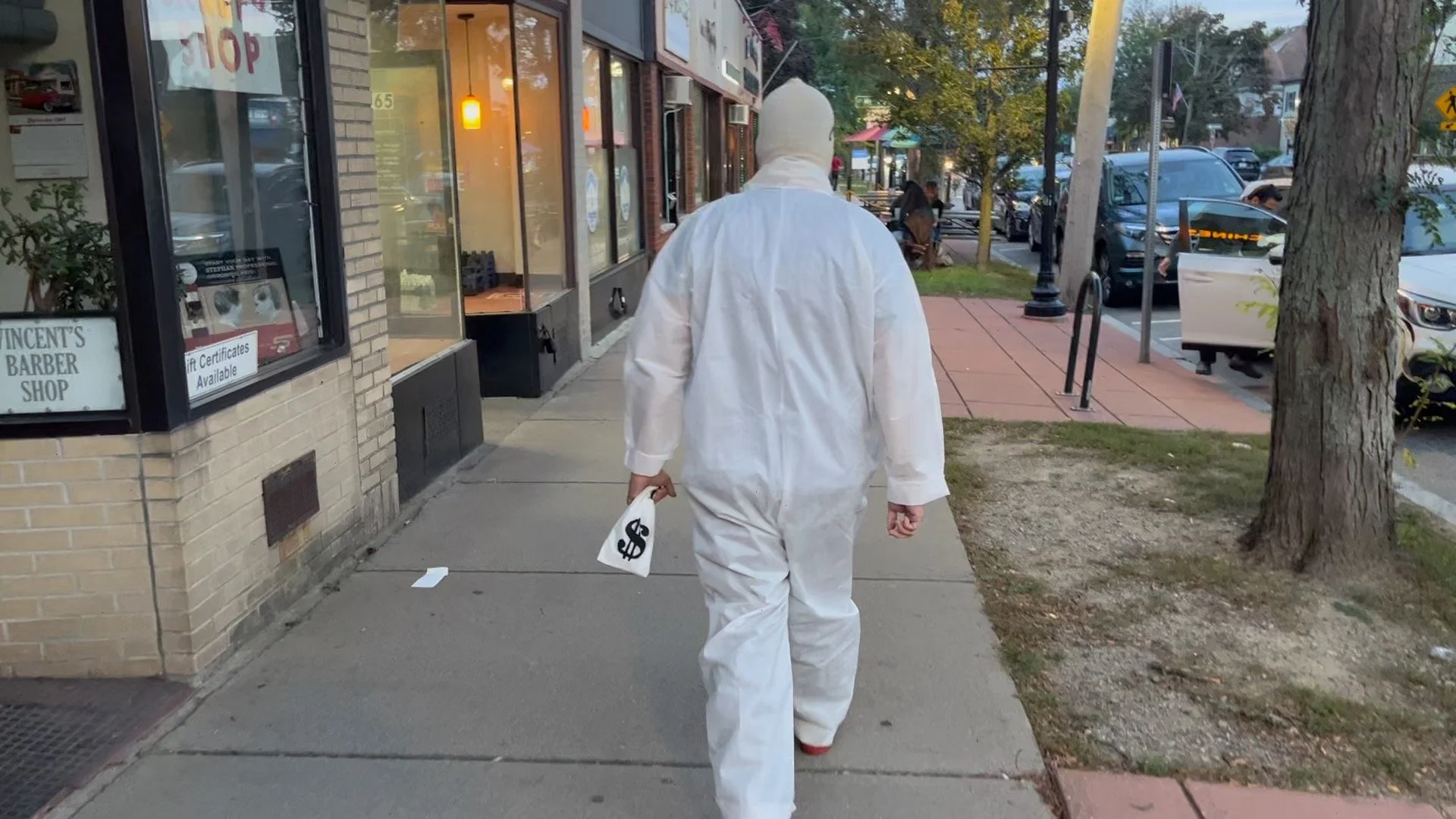
The bank sits on a pedestal in the gallery next to a pile of small prints of a photographic image of the piggy bank with the text. Visitors are invited to “leave a penny, take a print.” The piggy bank is also accompanied by an incomplete document that includes a photograph of the piggy bank and a balance sheet that will be completed by Galvan at the end of the Cashing Out performance. Throughout the duration of As Luck Would Have It, visitors to the gallery have been leaving change in the piggy bank and receiving a print in exchange. At the closing reception, Galvan will wear an outfit that indicates they are an ‘artist at work.’ Galvan will shake out the piggy bank, smash it, and count the money collected. Galvan will then take the money to a convenience store across the street from the gallery and buy a lottery ticket, which they will return to the gallery to scratch off to document any winnings.

When You See Unusual Misfortune (1/10), archival print, work-in-process

R. Galvan - Artist at Work


Cashing Out - Full Performance


R. Galvan is an artist based in Medford, Massachusetts. Their practice focuses on vanity and on the role systems play in shaping an understanding of memory and the self. With a special focus on queerness and Latinx subjectivity, their work manifests as image making, drawing, and critical research and writing. They have completed residencies with Brashnar Creative Project, Staccion Center for Contemporary Art, the School of Machines, Making and Make Believe, and the Kolaj Institute. Galvan received a Bachelor’s degree from Brown University, a Masters of Fine Arts from the Rhode Island School of Design, and a postdoctoral fellowship with Duke University’s program in Latino/a Studies in the Global South. Galvan has exhibited work at the National Humanities Center, the Urban Institute for Contemporary Arts, and internationally at the University of Coimbra (Portugal). They are a studio resident at the Boston Center for the Arts, an incubator for new creative projects.


As Luck Would Have It Artist Feature - Ted Ollier


One of the reasons we chose the very broad theme of ‘luck’ for our open call show As Luck Would Have It was to encourage a diverse range of responses and interpretations. Printmaker Ted Ollier took ‘luck’ to mean ‘randomness,’ and created a visual representation of a small bit of random data that we interact with in our daily lives. His Random Chroma Bands Type C series turns Two-Factor Authentication codes he received into a colorful pattern; read his full statement about the project below.


Random Chroma Bands Type C/p: 521964, archival inkjet print

Random Chroma Bands Type C/p: Grid of 361, archival inkjet print


Random Chroma Bands Type C illuminate and abstract a very commercial form of randomness now encountered on a daily basis. Whenever you sign in to your bank, shop on Amazon, or book something on Airbnb, you’re likely to be using 2FA, or Two-Factor Authentication. Once your login is entered at the relevant site, a code is sent to your phone or email address, and you use that to confirm the login. However, you only have ten minutes to act, before that code expires.

Well, these codes are little six-digit snippets of on-demand randomness. They are supposed to be inimitable, unpredictable, and evancescent. They provide the seed for generating the Random Chroma Bands. In these pieces, I have taken the resulting digits and encoded them further using my alphanumeric synaesthesia — the colors I associate with each of the ten ordinal digits. The six numbers become six identical bands of color that still retain that numerical information, just not as numbers. 

This renders the random number string into an aesthetic design, which can be appreciated by itself, or in groups with other Random Chroma Bands. In the grid piece displayed, 361 of these codes, specifically drawn from my personal PayPal account, have been turned into a 19x19 grid of bands that interplay and weave with each other in a way perhaps not quite envisioned by the developers who programmed this process.


Ted Ollier was born in the Midwest, lived in the South, and now resides in the Northeast. He has been a photographer, graphic designer, bass player, typographer, web pioneer, informational leafblower and armchair philosopher. He has also worked a variety of day-jobs, the details of which are not terribly important.

He holds degrees from the University of Texas, Texas State University and the Massachusetts College of Art and Design. At present, he is a printmaker and conceptual artist working in the Boston community of Medford. He teaches letterpress and design through the Harvard Extension School at the Bow & Arrow Press in Cambridge. Ollier is the Pressmaster of Reflex Letterpress in Charlestown.

His concerns are with data and its interaction with the consensus reality, and how that reality is affected and changed by that data. Oftentimes the simplest visual representation of a dataset is enough to engage the viewer in ways far beyond the naïve reading of that information. Although the didactic element of information transfer is always present in his work, his true focus is on revelation and enlightenment, and the joy of finding a previously-unnoticed detail in the landscape of life.

He lives with a patent attorney, a small human, a chow mix and a red tabby.