
At the beginning of this month, Marc and I cashed in a JetBlue voucher and flew to Los Angeles to visit family and friends. Given the immensity of Los Angeles and the near-absolute demand it makes to have access to a car, Marc and I were fortunate to be with people whom we love and who happened to have wheels and a great knowledge of what was where and what was interesting. Two of the high points of the visit were a private tour of the Universal movie lot (where Marc’s stepbrother works) and driving through Laurel Canyon, where we saw the houses of former 1960s neighbors Joni Mitchell, Frank Zappa and members of the band Canned Heat. In 1969 Canned Heat accidentally burned their house to the ground, which gave Steppenwolf the backdrop for the cover photo on their quite awful album At Your Birthday Party.
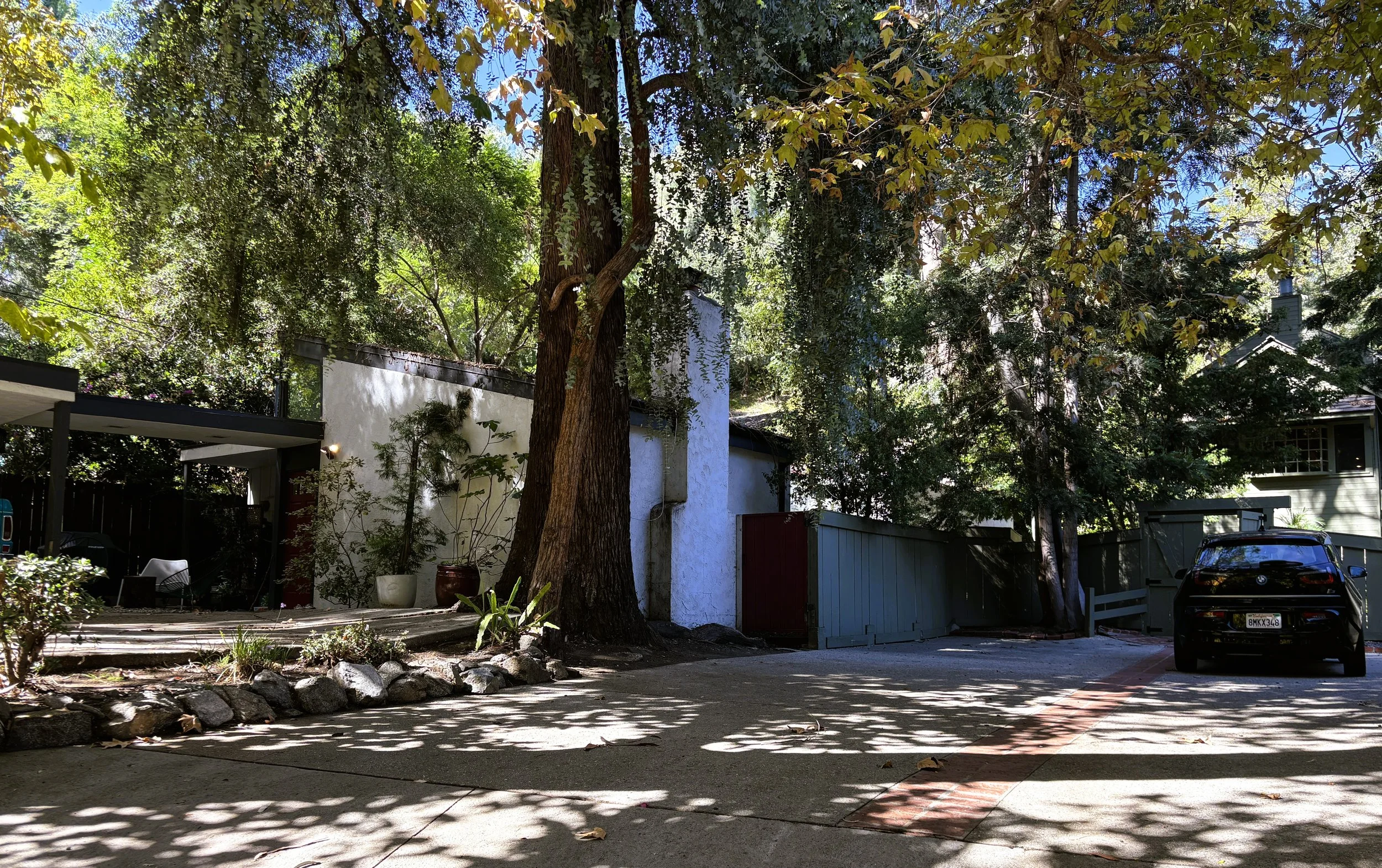
Joni Mitchell’s house in Laurel Canyon, where she wrote the albums Clouds (1969) and Ladies of the Canyon (1970)
There were other sites in Los Angeles over which Marc and I had different views. Two of the major ones were the new Geffen Galleries, a concrete-and-glass bunker hovering across the campus of the Los Angeles County Museum of Art, and the billion-dollar, spaceship-shaped Lucas Museum of Narrative Art. Are they innovative and stimulating contributions to the public from entertainment moguls David Geffen and George Lucas, or monuments to the vast wealth of America’s oligarchy? Of one thing we were certain: the Yoko Ono retrospective at The Broad was brilliant, optimistic and largely designed for the public to contribute to it.
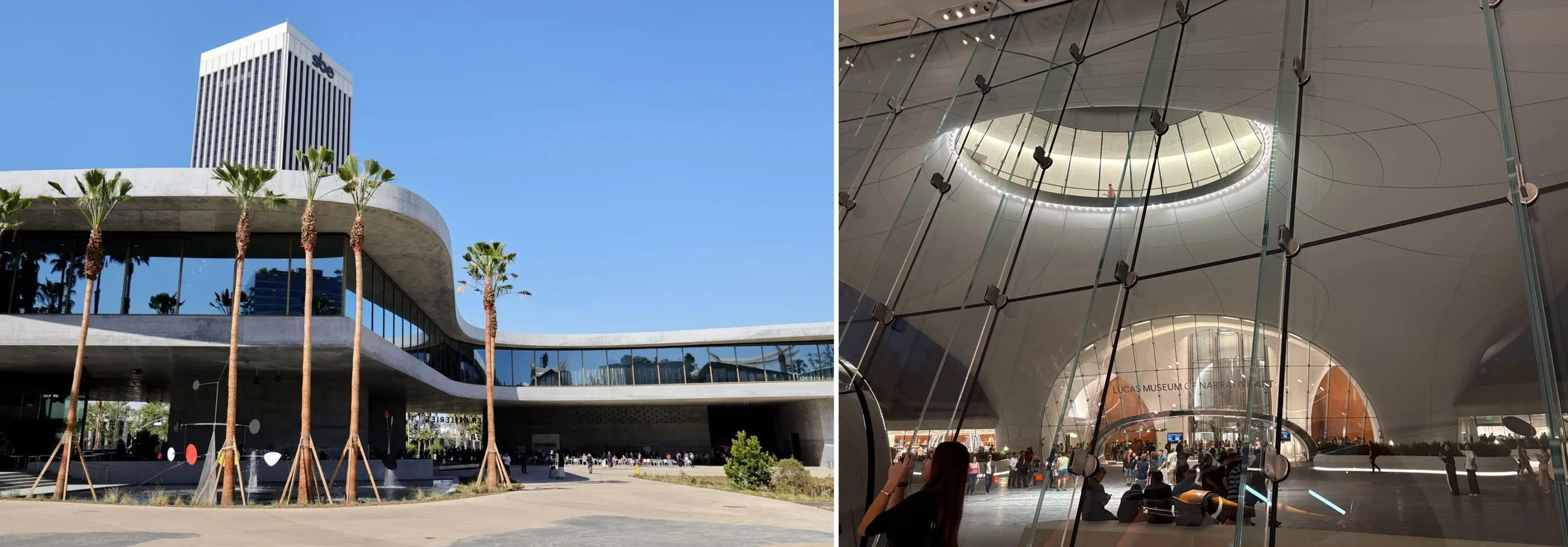
Geffen Galleries at the Los Angeles County Museum of Art (left) and a view into the central plaza of the Lucas Museum of Narrative Art (right)
Titled Music of the Mind, the retrospective closed on October 11. Organized by Tate Modern in London, where it opened in 2024, it was Ono’s first solo museum exhibition in Southern California, and it traced more than seven decades of an artist who has moved freely among conceptual art, performance, film, music and activism - always activism. The show began with the short “instruction” pieces she had started writing in the mid-1950s, works that replace the finished object one would expect to find in a gallery with an idea to be carried out or simply imagined. It then led us through her years in the downtown New York avant-garde, her peace campaigns with John Lennon and the large installations of recent decades. Along the way visitors were freely invited to hammer nails into a wall, read and add to graffiti and notes left by strangers, and tie wishes to olive trees, so that by the end it was hard to say where Ono’s work stopped and ours (and everyone else’s) began.
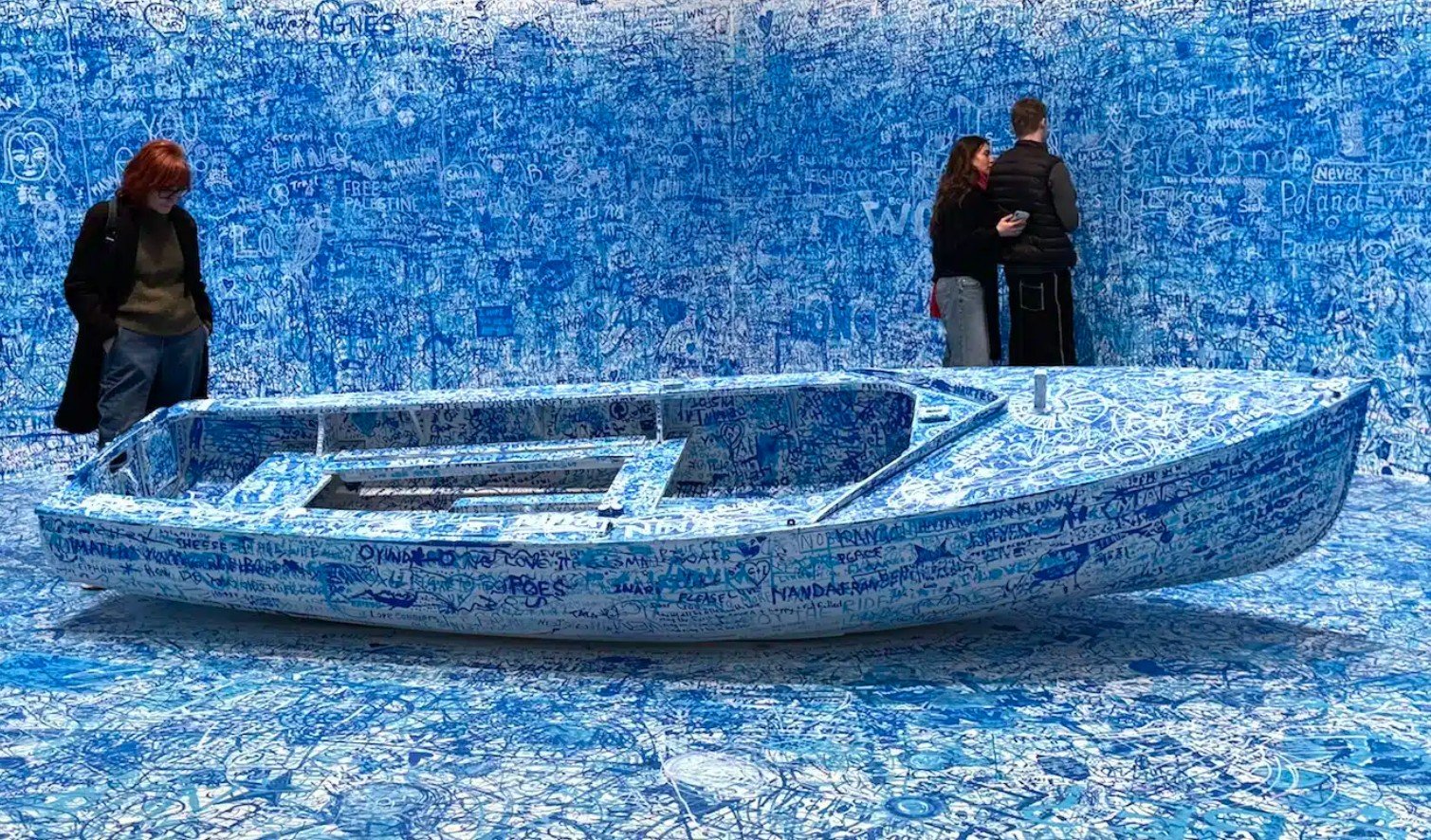
Add Colour (Refugee Boat), 2026, room, skiff and paint markers (photo credit: Artlyst)
Three of the works that keep returning to me were titled Add Colour (Refugee Boat), My Mommy is Beautiful and Wish Tree for Los Angeles. With instructions written by Ono, all three installations had been previously completed by visitors who, following Ono’s instructions, had attended exhibitions dating as far back as 1960. On the retrospective’s opening day, Add Colour consisted of a pristine white, 20' x 20' room with a small wooden skiff leaning on its side in the middle of the floor. It too was white. Ono’s instruction to visitors was simply to write something on anything in the room with one or all of four blue, gray and white markers resting in a tray. Between the show’s opening and our visit, the walls, the floor and the skiff had been covered in a soothing wash of layered prayers, scribbles, cartoons and captions in multiple languages. To enter the room by then was to enter an ocean simultaneously enjoyed for leisure and tragically crossed by people in search of freedom. Here was an ongoing saga, a history of pleasure and migration, the latter of which struck me hardest when I noticed someone had written, amidst this visual cacophony, “am I alone?” The ocean is neither soothing nor cruel; humans make it so.
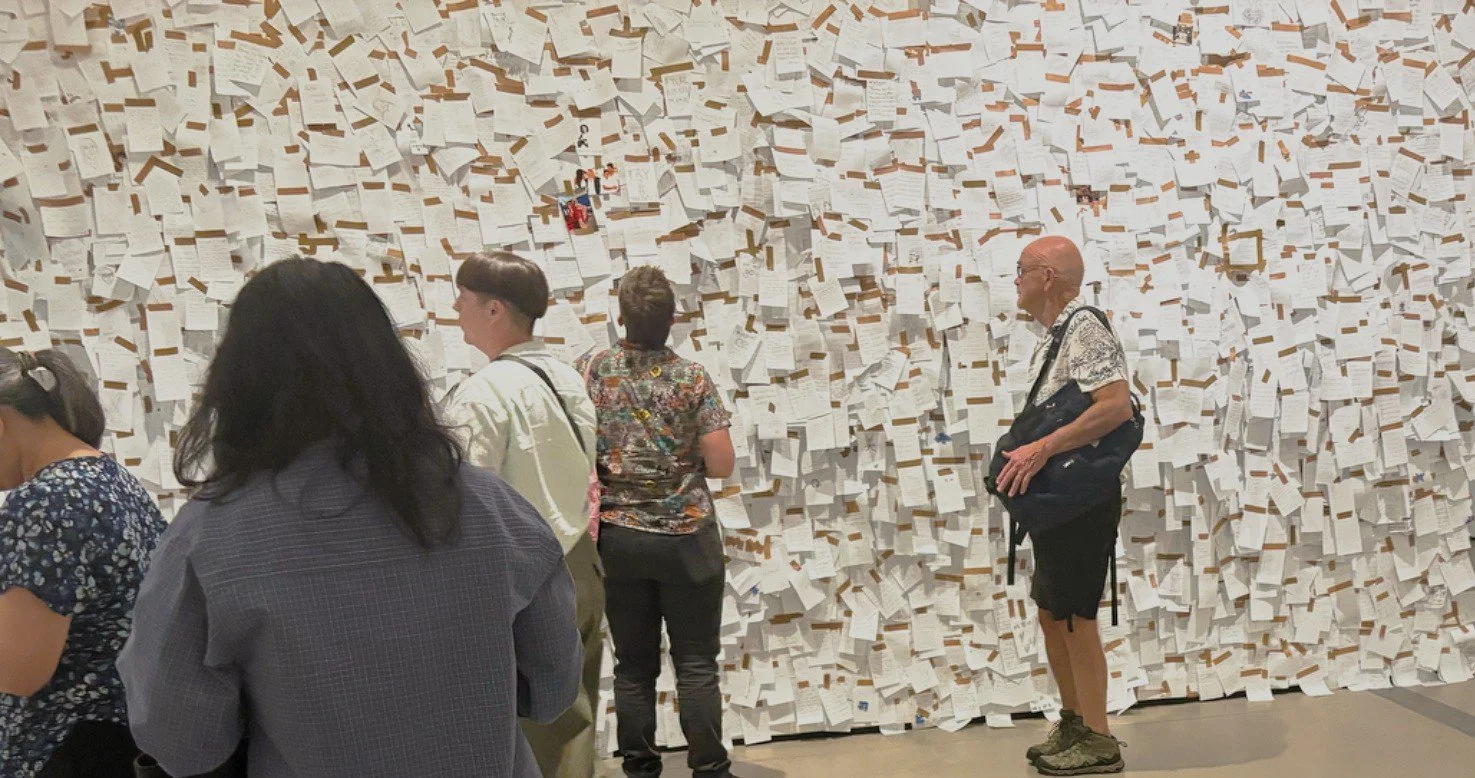
My Mommy Is Beautiful, 2026, room, Post-Its, graphite, tape
The poignancy of Add Colour continued into an adjacent room, where the white walls of My Mommy Is Beautiful shimmered with Post-Its bearing a half-year of messages from visitors to their mothers. In multiple languages the messages created a portrait of the complexities of not just motherhood, but also of our relationships to those who bore us, raised us, loved us (or not), nurtured us (or not) and grew old. What people wrote was loving, questioning and regretful and, like the blue boat, evocative of life journeys.
I became nearly overwhelmed by these two installations, so, to clear my head, I went outside to sit in a small grove of olive trees in the museum’s courtyard. From a rock under the canopy, I looked at passersby, at moss growing on tree roots and then up the mottled tree trunk in front of me, until I saw thousands of tags fluttering in the warm night breeze. I had come outside to escape the voices in the galleries and here, unexpectedly, I found myself sitting among thousands more. As in Add Colour and My Mommy Is Beautiful, the grove was alive with the silent thoughts of people who were no longer there. Where the rooms inside had carried the solemnity of passage, loss and memory, the trees held a solemnity of hope every bit as human. This was Ono’s Wish Tree for Los Angeles. Visitors had tied personal wishes to the branches: some for peace, others for health and love and still others, written by children, for pets and bicycles.
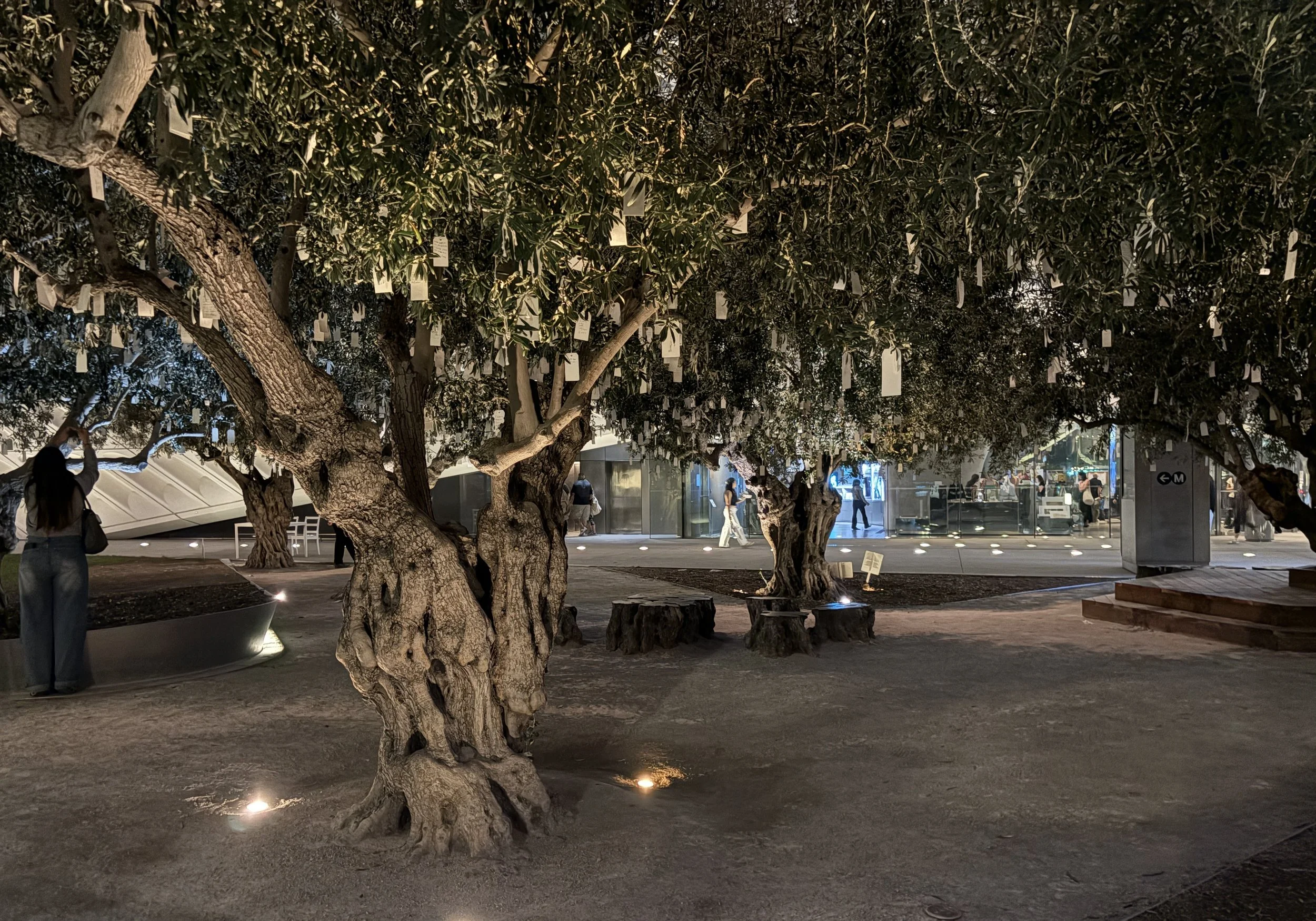
Wish Tree for Los Angeles, 2026, olive trees, paper tags, string, graphite
In the exhibition text, Ono traced the idea for Wish Tree back to her childhood in Japan, where people knotted prayers to trees on temple grounds. All of the tags from the grove at The Broad, like those written during Ono’s previous exhibitions, have since been gathered and will become part of a capsule of human voices buried at the base of Ono’s permanent work Imagine Peace Tower in Iceland. The tower, unveiled in 2007, is a tall column of light that shoots up into the sky from a white stone base bearing the words “imagine peace” in two dozen languages. It is lit each year from October 9, John Lennon’s birthday, through December 8, the anniversary of his death. The wishes buried around it now number well over a million, gathered from wish trees all over the world, so every tag tied to a branch in Los Angeles is meant to join that collection and become part of the light.
Before leaving the olive grove, I wrote a wish of my own, “long life to you all,” and tied it to a branch of a tree that will likely outlive us all. On the flight back to Boston two days later, I found myself sorting Los Angeles into two kinds of monuments. There were the ones built by moguls, enormous and expensive, the nature of which Marc and I will no doubt go on cheerfully disagreeing for years. And there were the ones built by everybody else, a burned-out house that became an album-cover photo, a white room that became an ocean, a wall of Post-Its that became a portrait of our mothers and a grove of olive trees heavy with wishes that will someday become light in the North Atlantic. Ono has spent seven decades insisting that what we make together outlasts what any one of us can build alone, and after an evening in her company I am inclined to believe her. If there is a lesson in all this for the traveler, it is a modest one: leave room for the unexpected and simply love.
- Jim Kiely
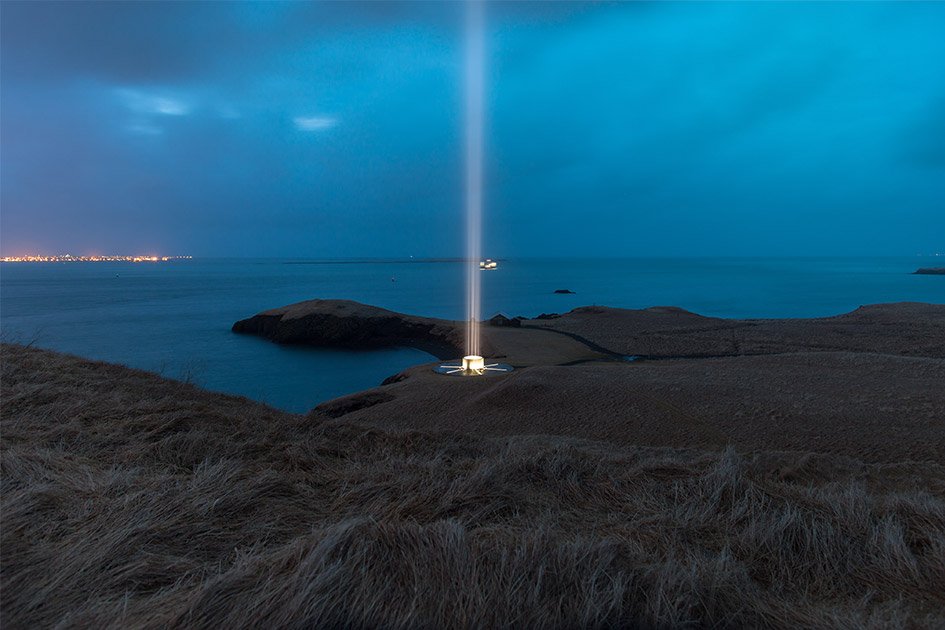
Imagine Peace Tower, Viðey Island, Iceland, 2007 (photo credit: My Hidden Gems)